

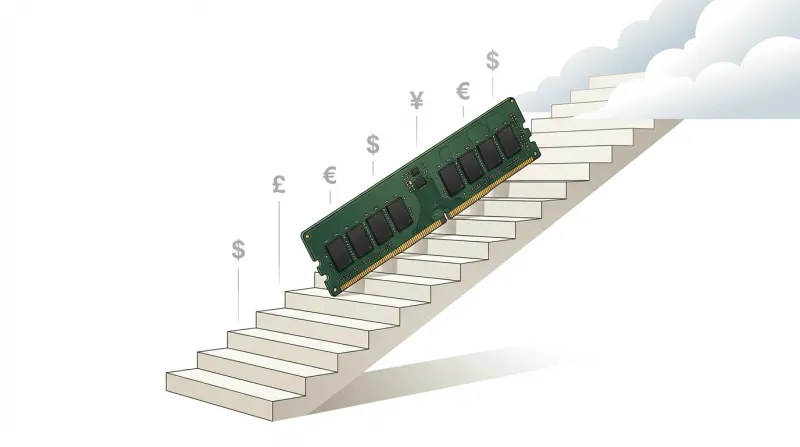
RAM prices are still rising in October 2026, and they don't look like they will get cheaper anytime soon. Both DDR4 and DDR5 have become much more expensive recently. In the last 30 days alone, DDR5 prices have risen about 16%, while DDR4 prices have risen nearly 13%. According to RAM price trackers, DDR5 now costs about $19–20 per GB, compared to $8–9 per GB for DDR4.
The main reason behind these increases is the growing demand for memory from AI infrastructure and data centers. Major manufacturers are prioritizing high-bandwidth memory (HBM) and server products, leaving less production capacity available for conventional DDR4 and DDR5 modules. Even weaker demand from consumer PC manufacturers hasn't brought prices down.
We can already see these price increases in the offers we get from our hardware suppliers here at Bacloud. For example, some 32GB DDR5 memory modules are now quoted at $565–570. At these prices, adding more RAM to a server or building a new one costs a lot more than it used to.
And it doesn't look like RAM will get much cheaper anytime soon. Most market forecasts suggest prices will stay high throughout 2027. We might see some improvement toward the end of 2027, but prices could take until 2028 to return to more normal levels.
Are you looking for a trusted partner in the web hosting market? Bacloud is a global provider offering a wide range of services—from small-business hosting to enterprise solutions—across multiple locations worldwide.
Check out Bacloud services
October 2026 RAM Price Trends
RAM prices kept rising in October 2026, and both DDR4 and DDR5 are now much more expensive than a few months ago.
According to RamRadar, DDR5 desktop memory costs around $18–20 per GB, while DDR4 costs about $7–9 per GB. Over the past 30 days, DDR5 prices have risen 16.1%, and DDR4 prices have risen 12.8%.
From October 1–29, the average DDR5 price was $18.51 per GB, up 8.4% from September. DDR4 averaged $8.07 per GB, up 5.6%.
The numbers make one thing clear: RAM prices are still rising, and October brought no real improvement for anyone looking to buy or upgrade memory.
Official analysis echoes the uptrend. TrendForce’s October 2026 market bulletins note consumer DRAM contract prices are still rising (though more slowly). For example, the Oct. 28 bulletin states that as suppliers “phase out DDR4, consumer DRAM contract prices are rising moderately this quarter”. The Oct. 21 bulletin warned DDR5 is “hard to source amid tight supply” and that vendors are aggressively widening price hikes in 4Q contracts. In sum, contract quotes are climbing, spot prices remain high, and distributors report that quotes now change daily or even hourly.
Trend: Rising. With each quarter of 2026 showing double-digit price jumps (Q1 DRAM +90–95%, Q2 +58–63%, Q3 still very high), October’s data show the trend continues upward, albeit more slowly. In the spot market, TrendForce data tracked by industry shows the DDR4 chip price (1 Gbit 3200MT/s) spiked to about $46 by late Sep 2026 (from ~$12 a year earlier) – a record high. Module prices reflect this: a 32GB DDR5-5600 kit jumped from ~$191 in Aug 2025 to ~$1,118 by Aug 2026, illustrating why consumers are feeling the crunch.
Demand Drivers: AI Servers vs Consumer PCs
The price surge is not driven by consumer PC demand. In fact, PC OEMs have built up inventory and are cutting future orders. Smartphone makers also slowed buying after early stockpiling. Instead, the AI/data-center boom is the dominant force. Hyperscale cloud providers are locking up DRAM/HBM supply for AI servers, leaving little for ordinary PCs. For example, TrendForce and analysts say that every wafer shifted to high-bandwidth memory (HBM) for AI means losing roughly three wafers of DDR4/DDR5 capacity. Nvidia even negotiated a $500 billion multi-year memory deal for its AI accelerators.
As a result, buyers report frantic conditions: a recent enterprise quote for 400×64GB DDR5 modules hit over $1 million, with prices changing so fast that quotes expire in hours. Spot-market tracking shows server 32GB RDIMM modules up ~35% in two months (July to Sept 2026). In short, AI-driven data center orders are soaking up supply and driving up DRAM spot prices across the board.
By contrast, demand from PC builders is relatively weak. PC DRAM supply will actually shrink next year (as lines shift to HBM) and firms are pulling back on purchases. In plain terms, the money is in enterprise AI gear right now, and commodity memory buyers have little negotiating leverage.
Bacloud B2B Price Examples vs. Market
We can also see how much RAM prices have increased by looking at the offers we receive from our hardware suppliers here at Bacloud. In October, 32GB Crucial DDR5-5600 memory modules were priced at around $565–570 each. A 32GB Samsung DDR5-5600 SODIMM was offered at $405.
These prices are not far from what we see in the wider market. According to RamRadar, the median price for DDR5 desktop memory in October was $18.03 per GB, or about $576 for 32GB. Laptop memory (SODIMM) was slightly cheaper, averaging $16.84 per GB, or roughly $539 for 32GB.
This means our suppliers' Crucial prices are close to the market average, while the Samsung SODIMM offer is noticeably cheaper. Either way, buying large amounts of RAM for new servers has become a lot more expensive.
| DDR5-5600 UDIMM (Crucial) | $565–$570 (Brand new) | $18.03/GB ≈ $576 total |
| DDR5-5600 SODIMM (Samsung) | $405 (Brand new) | $16.84/GB ≈ $539 total |
| DDR5-5600 UDIMM (Samsung) | $70 (Brand new)* | $18.03/GB ≈ $576 total |
Forecast: When Will Prices Fall?
RAM prices are unlikely to come down anytime soon. According to TrendForce and other market analysts, memory will remain expensive throughout 2026 and probably well into 2027.
TrendForce expects prices to rise by another 10–15% in the fourth quarter of 2026. That's much slower than the roughly 60% increase in the second quarter, but prices are still rising.
The shortage is also expected to continue. Apacer's CEO has warned that serious memory shortages could last until at least mid-2027. Other forecasts from Gartner and Counterpoint suggest the market may not improve until late 2027.
For anyone planning to buy RAM or upgrade servers, this means waiting a few months probably won't save much money. Prices could keep rising before they finally start to fall.
The underlying reason is the lag in capacity build-up. New DRAM fabs take 18–24 months, and most planned expansion is already earmarked for HBM/AI memory. TrendForce expects high-demand server DRAM prices to keep rising throughout 2027. All told, buyers should not count on any significant DDR4/DDR5 price decline until at least mid‑2027 (some say late 2027).
Conclusion: What Should RAM Buyers Do Now?
RAM prices are still going up, and there is little reason to expect them to drop in the coming months. Both DDR4 and DDR5 became more expensive in October 2026, mainly because memory manufacturers are focusing more on AI and data center customers.
The problem is not just high demand. Manufacturers are also shifting more resources to HBM memory, which powers AI hardware. At the same time, DDR4 production is declining, making older memory harder to find.
Companies plan to build new memory factories, but they won't solve the shortage overnight. Bringing new production online takes time, and much of that extra capacity is intended for AI products. We may have to wait until late 2027 or even 2028 for RAM prices to return to more normal levels.
Businesses planning new servers or memory upgrades should check prices and availability before deciding. If you know you will need more RAM in the coming months, buying early or locking in prices with a supplier could help you avoid further increases. Keeping existing DDR4 servers running for longer may also be worth considering.
At Bacloud, we can already see how much the market has changed. Some suppliers now ask around $570 for a single 32GB DDR5 module. At the same time, always check unusually cheap offers carefully to make sure the listed specifications and prices are correct.
For now, remember that cheap RAM is unlikely to return anytime soon. Prices may stop rising so quickly, but that doesn't mean they will start falling. Anyone planning to buy large amounts of memory should watch the market and prepare for higher hardware costs throughout 2027.