

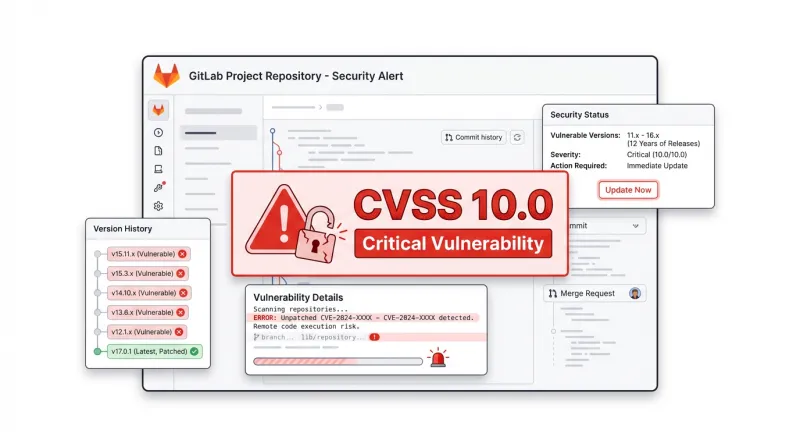
 On October 21, 2026, GitLab released a security update to fix a serious vulnerability that could allow hackers to execute malicious code on GitLab servers without logging in. The vulnerability, known as CVE-2026-110264, has a CVSS score of 10.0, the highest possible rating.
The issue affects both GitLab Community Edition (CE) and Enterprise Edition (EE), including older versions dating back to 2014. GitLab recommends that anyone running GitLab on their own servers install the security updates as soon as possible.
The update also addresses 11 additional security vulnerabilities, including two rated as high severity.
What Is the Critical GitLab Vulnerability?
CVE-2026-110264 is an integer overflow vulnerability affecting GitLab's regular expression compiler. Under certain conditions, an unauthenticated attacker could exploit the flaw to execute arbitrary code on a vulnerable GitLab server.
An integer overflow happens when software tries to handle a number too large to process correctly. In this case, attackers could use specially crafted text to cause memory errors and potentially run malicious code on the server.
According to GitLab, the vulnerability can be triggered when the system processes a specially prepared Org-mode file, a text file format used for documents and notes. The problem is related to how GitLab's Ruby regular expression engine handles certain content.
What makes this vulnerability particularly dangerous is that attackers do not need an existing GitLab account or valid login credentials to exploit it under the affected conditions.
The vulnerability was reported by security researcher joaxcar through GitLab's HackerOne bug bounty program.
Are you looking for a trusted partner in the web hosting market? Bacloud is a global provider offering a wide range of services—from small-business hosting to enterprise solutions—across multiple locations worldwide.
Check out Bacloud services
What Could Happen If a GitLab Server Is Compromised?
Development teams widely use GitLab to store source code, manage projects, and automate software deployments through CI/CD pipelines. A successful attack against a GitLab server could therefore affect much more than the platform itself.
According to GitLab's security detection documentation, successful exploitation could allow an attacker to execute code under the GitLab service account, typically the git user.
Depending on the server configuration and available permissions, an attacker could potentially access private source-code repositories, steal authentication tokens or CI/CD secrets, compromise development workflows, or disrupt GitLab services.
Stolen deployment credentials could also create risks for other systems connected to GitLab, including production environments.
The vulnerability does not automatically grant an attacker root access to the underlying operating system. However, even access through the GitLab service account could expose sensitive development infrastructure.
Which GitLab Versions Are Affected?
The vulnerability affects GitLab CE and EE versions starting from 7.0, released in 2014, through vulnerable releases of GitLab 19.5.
GitLab has released the following patched versions:
- 19.5.1
- 19.4.3
- 19.3.6
- 19.2.9
- 19.1.9
- 19.0.10
- 18.11.13
Organizations running older installations must follow GitLab's supported upgrade procedure to reach a patched release.
The unusually broad range of affected versions prompted GitLab to backport the security fix to several older release branches outside its standard maintenance policy.
On October 12, 2026, GitLab released an update to fix another critical security issue (CVE-2026-97229) that could let attackers run malicious code on servers. However, this update does not fix CVE-2026-110264, so users who installed it still need to update GitLab again.
GitLab.com has already been patched, so customers using GitLab's hosted service do not need to take additional action. GitLab Dedicated customers running the specified patched internal releases are also protected.
Other Security Vulnerabilities Fixed
The October 21 release addresses 12 security vulnerabilities in total, not just CVE-2026-110264.
Among the other significant issues are:
CVE-2026-15723 (CVSS 8.2): An authentication vulnerability involving OmniAuth and LDAP account linking. Under specific configurations, an authenticated attacker could potentially take over another user's LDAP-backed account.
CVE-2026-112212 (CVSS 7.5): A security issue that could allow attackers to change cached login settings and potentially redirect users to an external server during the login process.
The remaining fixes address several other weaknesses involving access controls, sensitive information exposure, authorization checks, and security policy enforcement.
Full details are available in GitLab's official security release announcement.
Is the Vulnerability Being Actively Exploited?
If you cannot install the update right away, consider temporarily limiting public access to your GitLab projects and disabling services you do not need. This may reduce attack risk, but it will not fix the vulnerability.
The vulnerability was also not listed in the US Cybersecurity and Infrastructure Security Agency's (CISA) Known Exploited Vulnerabilities catalog at the time of reporting.
However, the absence of confirmed exploitation does not mean that vulnerable servers are safe.
GitLab has published two security detection rules, Onigmo native worker crash and Org mode render error burst, to help administrators identify suspicious behavior potentially associated with exploitation attempts.
GitLab also warns that successful exploitation may not produce an obvious crash, meaning normal-looking server logs cannot guarantee that an installation has not been compromised.
What Should GitLab Administrators Do?
The most important recommendation is to install the security update immediately. GitLab has not provided a complete workaround that can replace patching.
Administrators should verify their installed GitLab version, plan the upgrade using the official upgrade documentation, and review server logs for unusual activity.
If you cannot install the update right away, consider temporarily limiting public access to your GitLab projects and disabling services you do not need. This may reduce attack risk, but it will not fix the vulnerability.
Before upgrading, administrators should also verify that recent backups are available. Some patch releases include database migrations that may require maintenance downtime.
If there is evidence of successful exploitation, rotate potentially exposed credentials and access tokens, and investigate the affected systems.
Final Thoughts
CVE-2026-110264 is one of the most serious GitLab vulnerabilities disclosed in 2026, combining a maximum CVSS score with the possibility of unauthenticated remote code execution.
Because GitLab frequently stores sensitive source code and credentials used in software deployment, a compromised instance could create serious security risks across an organization's infrastructure.
Although active exploitation has not been publicly confirmed, GitLab administrators should not delay installing the available patches.
The full security advisory and fixed versions are available on the official GitLab website.