

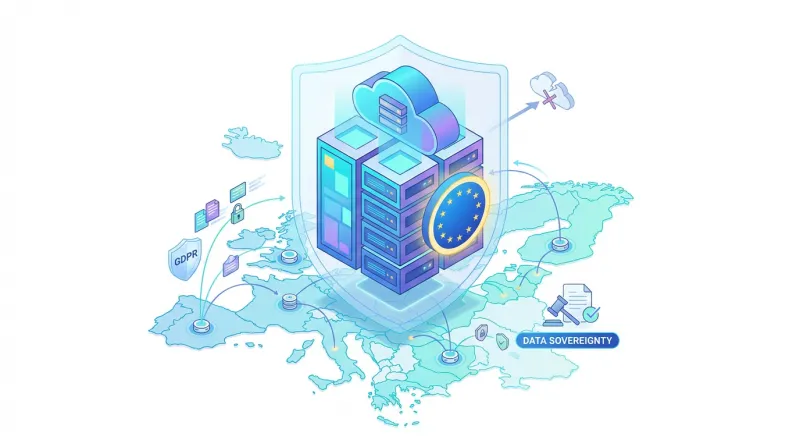
 Choosing a sovereign hosting provider in Europe means deciding who will run the infrastructure behind your business. That choice deserves attention in a market where European providers hold about 15% of the regional cloud market, while AWS, Microsoft, and Google account for around 70%. The provider you choose will influence where your data is located, which laws cover it, who can access your systems, and how easily you can move your services in the future.
What is a sovereign hosting provider?
A sovereign hosting provider stores and manages an organization’s data within a defined legal and geographic jurisdiction. It gives customers greater control over data location, administrative access, and the laws that govern their hosting environment.
This matters when applications handle customer records, financial information, health data, or internal business systems. Keeping these workloads in a European data center can support data protection requirements and make it easier to explain where information is stored and who manages it.
Just having a server in Europe does not automatically make a hosting service sovereign. A company may operate infrastructure in Lithuania or Germany while being owned elsewhere. Its support team may operate from another country, or its backup service may copy data outside the approved region.
Several related terms help explain the difference:
-
Data residency describes where data is physically stored and processed. This can include the main application, backups, logs, and recovery copies.
-
Data sovereignty concerns the laws and jurisdiction that apply to the data.
-
Operational sovereignty focuses on who administers the infrastructure and how it handles privileged access.
-
Digital sovereignty describes the customer’s control over areas such as encryption keys, software, and infrastructure decisions.
Before choosing a sovereign hosting provider in Europe, look beyond the primary server. Check where backups are kept, who can access production systems, and which company operates the infrastructure. These details show whether the provider offers true sovereign hosting or simply hosts its servers in Europe.
Why is sovereign hosting important in Europe?
Sovereign hosting matters because moving an application to the cloud also means placing part of the business under another company’s control. That decision affects more than server performance. It can influence how an organization handles customer data, responds to audits, manages legal risk, and continues operating during a disruption.
For a European business, keeping data within the required jurisdiction can make its compliance responsibilities easier to manage. It also gives the company a strong answer when customers, regulators, or business partners ask where their information is stored and who can access it.
The hosting provider's ownership and legal structure also matter. Data may be physically located in Europe while the provider is subject to laws or corporate control from another country. That can create uncertainty when authorities request access or when international tensions affect technology suppliers.
Sovereign hosting in Europe can also support long-term independence. A company that understands where its data, backups, and infrastructure are managed is better positioned to make the right decisions about security, suppliers, migration, and growth.
Sovereign hosting is therefore as much a business decision as an infrastructure decision. The right provider should give leadership confidence that important data and systems are governed according to the organization’s requirements.
Key features to look for in a sovereign hosting provider
A hosting provider may advertise European infrastructure without offering meaningful data sovereignty. To understand what you are actually buying, look beyond the server's location and examine how the provider is owned, operated, secured, and supported.
Clear European ownership and jurisdiction
Check the provider’s legal structure. Find out where the company is incorporated, who owns it, and which laws govern your contract. A server hosted in Europe may still be operated by a company controlled from outside the region.
This matters because foreign ownership can create additional legal exposure. Check whether the provider has a non-European parent company and whether another country’s data-access laws could apply to the service. The provider should explain these details in its legal and security documentation.
Verified data residency
Confirm where your data is stored throughout its lifecycle, not only when the application is running. This includes production databases, snapshots, backups, replicated storage, logs, metadata, and disaster-recovery copies.
A provider saying that it has “European data centers” does not tell you whether every copy of your data is in Europe. If your business requires data to be in a particular country, ask whether you can select that location and whether the same restriction applies to backups and recovery systems.
Local administrative access and support
The people managing the infrastructure can access systems even when the servers are located in Europe. Check where administrators and support engineers are based, who can access your environment, and whether remote access from outside Europe is allowed.
Also check how privileged activity is handled. Stronger providers document approval procedures, use role-based access, require multi-factor authentication, and log administrative actions. Also find out whether external support or maintenance companies can access your systems.
Strong security and customer control
Security controls should cover both the provider’s infrastructure and your own account. Look for encryption in transit and at rest, access controls, multi-factor authentication, audit logging, DDoS protection, and a documented incident-response process.
Some organizations also need to manage their own encryption keys. If that matters for your compliance model, confirm whether the provider supports customer-controlled keys instead of assuming all hosting plans include this option.
Dedicated or single-tenant infrastructure
Dedicated servers provide physical separation from other customers and give organizations a clearer view of the hardware running their workloads. They can suit regulated applications, sensitive databases, and systems that require predictable performance.
Shared cloud hosting is not unsuitable. The right choice depends on your risk assessment, isolation requirements, workload, and budget.
Transparent infrastructure and subcontractors
Also check which components the provider operates itself and which it handles through third parties. Data-center operations, backups, monitoring, network connectivity, security services, and technical support may involve separate companies.
These dependencies do not disqualify a provider. The important point is that they should be disclosed, documented, and consistent with your data sovereignty requirements.
How to evaluate a provider before you commit
Once you understand the features of sovereign hosting, test whether the provider can support those requirements in daily operation. The following checks focus on European jurisdiction, data control, and long-term independence.
Validate the deployment location
Ask the provider to confirm the exact European data center where your server will run. Then confirm where its attached storage, backups, monitoring data, and disaster-recovery copies are held, since they may use separate locations.
Trace the full data path
Map where application data travels after deployment. Include logs, snapshots, support files, container images, and third-party services because sovereignty can be lost outside the main server.
Request evidence of jurisdictional control
Ask for the provider’s registered company details, ownership information, applicable contract law, and administrator-access policy. These documents show whether the service is governed from the required European jurisdiction.
Test access and audit controls
Review how engineers access customer systems during maintenance or support. Confirm that privileged access requires authorization and produces an audit record.
Review the subprocessor chain
Request details of the companies involved in data-center operations, network services, backups, monitoring, and support. Check whether any of them operate outside your approved region.
Check recovery within Europe
Run a backup restoration test and confirm where the recovery environment is created. A European production server is not sufficient if disaster recovery sends the workload elsewhere.
Read the sovereignty terms in the contract
Make sure the agreement includes data location, access restrictions, incident notification, and jurisdiction. A statement on a marketing page may not provide the same protection.
Test portability
Export a backup or machine image and confirm that it can be restored on another platform. This gives your team an exit option if the provider’s ownership, policies, or locations change.
Assess the provider’s European capacity
Check whether the provider can add resources or support another approved European location without forcing a complete redesign. This is important if your compliance scope or customer base expands.
Sovereign hosting vs. cloud hosting: Which is right for you?
Sovereign hosting and cloud hosting are not always direct alternatives. Sovereign hosting describes where infrastructure is governed and who controls it. Cloud hosting describes how computing resources are delivered. A cloud platform can therefore be sovereign if it meets the required ownership, jurisdiction, access, and data-residency conditions.
The comparison below treats “cloud hosting” as a conventional cloud service that may involve international ownership, distributed operations, or cross-region data transfers.
|
Buyer consideration |
Sovereign hosting |
Conventional cloud hosting |
|
Primary focus |
Keeps data and infrastructure under the required European legal and operational control. |
Provides on-demand computing resources through a European, international, or mixed infrastructure model, depending on the provider. |
|
Provider ownership |
Usually owned and governed within the required country or region |
May be owned or controlled by a company outside the customer’s jurisdiction |
|
Data location |
Customer can usually select approved locations and apply restrictions to backups and replicas |
Data may be distributed across regions depending on the service configuration |
|
Administrative access |
Provider should disclose where administrators are located and how privileged access is controlled |
Support and administration may involve global teams or third-party providers |
|
Infrastructure model |
May use dedicated servers, VPS, private cloud, or a sovereign public cloud |
Commonly uses virtual machines and shared infrastructure managed at scale |
|
Tenant isolation |
Dedicated or single-tenant options may be available for sensitive workloads |
Multi-tenant infrastructure is common, with isolation handled through software like hypervisors and virtual networks |
|
Scaling |
Scaling may involve adding dedicated hardware or expanding within a controlled regional platform |
Rapid scaling through APIs, templates, autoscaling, and global resource pools |
|
Portability |
Often favors standard servers, open tooling, and direct infrastructure control |
Proprietary services can make migration more difficult |
|
Best fit |
Regulated data, public-sector systems, sensitive databases, and organizations with strict jurisdictional requirements |
Applications whose traffic or resource demand changes frequently, cloud-native applications, rapid development, and global deployments |
Why choose Bacloud for sovereign hosting in Europe?
Bacloud gives organizations several infrastructure options for hosting your services in Europe, including dedicated servers, Linux VPS, Windows VPS, and cloud backup services.
For businesses that need stronger infrastructure isolation, Bacloud’s dedicated servers offer:
-
Single-tenant hardware reserved for one customer
-
Full root access and IPMI control
-
Custom configurations with AMD EPYC or Intel Xeon processors
-
NVMe, SSD, and HDD storage options
-
European deployment locations, including Lithuania and the Netherlands
Bacloud also supports private infrastructure setups involving VPN, BGP, VLAN connections, colocation, and cloud solutions. These options help technical teams design an environment around their workload, performance, and access requirements. Explore Bacloud’s dedicated servers and infrastructure services, or create a Bacloud account to get started.