

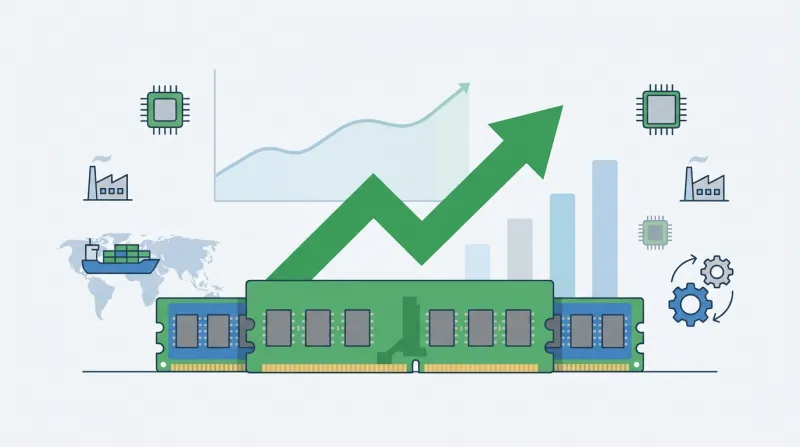
As of April 30, 2026, RAM prices are not yet in a true global downcycle. What April has shown is a split market: spot DDR4 and some channel quotes are drifting lower, but the enterprise and contract segments that matter most to OEMs and data-center buyers are still tight. TrendForce reported a steady but modest April decline in mainstream DDR4 spot pricing, while supplier commentary continues to point to strong server-memory demand and a market that has not fully rolled over.
The short reminder is simple. April commentary from Samsung Electronics and SK hynix in their 1st-quarter 2026 results described a market where demand remains strong, supply is constrained, and favorable pricing has not ended. TrendForce’s server outlook points in the same direction, with unmet demand expected to carry into 2027.
What changed in spot and channel pricing
The clearest April change is in spot DDR4, but it is a cooling trend, not a collapse. Weekly updates show the average spot price for mainstream DDR4 1Gx8 3200 chips moving from $33.96 on April 1 to $33.56 on April 7, $33.40 on April 14, and $32.50 on April 28. That is a month-to-date decline of about 4.3%, while TrendForce repeatedly described buyer behavior as cautious and transaction volumes as weak.
Current pricing is still mixed rather than broadly weak. On April 30, TrendForce’s live spot page showed DDR4 16Gb 3200 at a session average of $61.152, down 1.02%, while DDR5 16Gb 4800/5600 was $39.00, up 0.34%. On the module side, the April 20 benchmark showed DDR5 RDIMM 32GB 4800/5600 at $970 and DDR4 UDIMM 16GB 3200 at $148.868, both only slightly lower than the week prior. That is why buyers are getting conflicting signals: some products are easing, but not enough to call this a real market reset.
That same instability is visible in retail. A U.S. pricing tracker updated on April 23 said RAM prices are moving hour by hour, availability remains limited, and the best deals on higher-capacity kits disappear quickly. In other words, retail shoppers may catch occasional relief, but the market still behaves like a shortage market rather than a normal inventory market.
What the device market is telling us
Client devices are softer, but not soft enough to force a global RAM reset. According to the IDC press release, global smartphone shipments fell 4.1% year over year to 289.7 million units in the first quarter of 2026. In China, smartphone shipments fell 3.3% to 69.0 million units. PCs, however, still grew 2.5% to 65.6 million units in Q1, even as the rest of 2026 should weaken as system prices continue to rise.
That combination matters. Weak smartphones and cautious channels can pressure spot traders and create temporary markdowns, but steady server demand and still-resilient PC demand keep the overall market segmented instead of fully correcting. The strongest timing clue in April is that memory prices are expected to stabilize only in the second half of 2027. Stabilization is not the same as falling back to normal. It means buyers should not expect a broad, clean RAM reset in the near term.
What Bacloud is seeing in wholesale offers
That same segmentation is visible in the offers reaching Bacloud. The freshest server-memory quotes shared with us were concentrated in enterprise DDR5 rather than bargain desktop kits: Samsung M321R8GA0PB0-CWM — at $2,800; Samsung M321R8GA0EB0-CWM — at $2,750; Samsung M321R8GA0EB2-CWM — at $2,750; Micron MTC40F2046S1RC56BD1 — at $2,500; SK hynix HMCG94AGBRA632N — at $2,800; Micron MTC40F204WS1RC56BR — at $3,300; and Micron MTC40F2046S1RC56BD1T — at $2,310.
At the same time, Bacloud also received much cheaper DDR4 lots, including 16GB 2Rx8 PC4-3200AA at $10, 32GB 2Rx4 PC4-2400T at $14, 32GB 2Rx4 PC4-3200AA at $15, 32GB DDR4-2933 at $14, 32GB DDR4-3200 at $15, and 128GB DDR4-2933 LRDIMMs at $70. That does not look like a uniformly falling RAM market. It looks like a market where newer, server-grade DDR5 still carries a premium, while older DDR4 has started to offer tactical buying opportunities in slower and more price-sensitive wholesale channels.
Only DDR5 saw sporadic buying interest, while DDR4 price cuts failed to revive demand, and the module benchmarks were only modestly lower rather than deeply discounted. That is exactly what a segmented market looks like: limited softness at the edges, but no broad collapse in the premium segment.
The realistic window for lower RAM prices
So, when will RAM prices really drop? The April 2026 answer depends on the segment. Spot DDR4 has already started easing. Retail and channel DDR5 can move lower in short bursts when distributors clear inventory or buyers refuse high offers. But for mainstream OEM procurement, and especially for server DDR5, the April evidence still argues against a meaningful near-term decline. The most realistic base case is that Q2 could be the point at which price acceleration slows, not the point at which the market becomes cheap again.
For buyers planning deployments in Q2 or Q3 2026, waiting for a dramatic correction does not appear to be the strongest strategy. If there is flexibility, the best opportunities are still in older DDR4 inventory, selective spot-market deals, and secondary-channel lots. For a broader and cleaner normalization across the memory market, late 2026 is the optimistic case.