

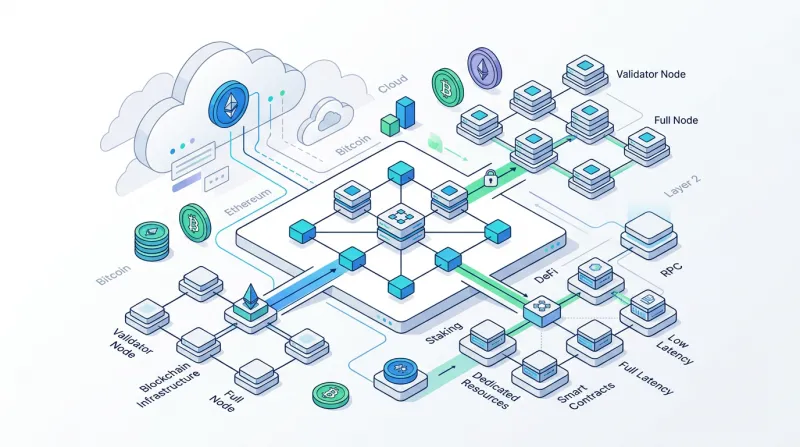
A blockchain node is rarely idle. It receives transactions, checks signatures, validates blocks, updates its database, and exchanges data with other nodes. If it also provides RPC access, it processes requests from wallets, dApps, exchanges, and blockchain explorers at the same time.
That heavy load can expose the limits of a virtual cloud server. Slow storage can delay synchronization, changing CPU availability can affect processing, and network latency can interfere with block propagation or validator communication.
What are bare metal servers for blockchain?
A bare metal server for blockchain is a physical, single-tenant machine dedicated to running blockchain software. Unlike a cloud virtual machine, it does not share its core hardware with other customers through a hypervisor. This gives blockchain operators direct access to the server’s CPU, RAM, storage, and network resources.
Common use cases
Bare metal servers are commonly used for blockchain services that run continuously or handle demanding workloads.
-
Validator nodes: Process consensus duties, propose or attest to blocks, and support staking operations.
-
Full nodes: Verify transactions and blocks while maintaining a local copy of the blockchain.
-
Archive nodes: Store extensive historical blockchain state for explorers, analytics, and application queries.
-
RPC infrastructure: Process requests from wallets, dApps, exchanges, block explorers, and other blockchain applications.
-
Blockchain indexing: Organize blocks, transactions, and smart contract data for search and analytics.
-
Crypto trading infrastructure: Support latency-sensitive trading systems that interact with blockchain networks and digital asset exchanges.
-
Private blockchain networks: Run enterprise networks that require dedicated hardware, controlled access, and isolated infrastructure.
-
Smart contract platforms: Provide the compute, storage, and networking needed to execute and test blockchain applications.
Power your blockchain projects with high-performance dedicated servers tailored for the cryptocurrency ecosystem. Whether running full nodes, validator nodes, mining software, trading platforms, or DeFi applications, Bacloud offers customizable server solutions built for stability and speed.
With powerful Intel Xeon or AMD EPYC processors, extensive memory options, and ultra-fast NVMe storage, our dedicated servers ensure your crypto infrastructure runs efficiently and securely. Full root access gives you complete service control.
Key characteristics of bare metal blockchain servers
These characteristics can help blockchain operators run their services continuously.
No hypervisor overhead
Bare metal avoids hypervisor overhead because the blockchain client runs on a dedicated physical server rather than inside a virtual machine.
A hypervisor is the software layer that divides one physical server into several virtual machines. Cloud providers use it to run multiple customer environments on the same hardware, with each virtual machine sharing access to the underlying CPU, RAM, storage, and network interfaces.
With bare metal, the blockchain client uses those physical resources directly. Since the server is dedicated to one customer, validators, full nodes, and RPC services do not compete with other users for the same hardware. This can make resource availability and workload performance more predictable.
Dedicated, single-tenant resources
Blockchain nodes need CPU and memory to validate transactions, verify blocks, execute smart contracts, update databases, and communicate with peers.
With bare metal, one customer uses the physical server, so unrelated workloads cannot consume its processor, memory, storage, or network capacity. This removes the noisy-neighbor problem found in shared environments and gives validators, full nodes, RPC services, and other blockchain applications more predictable access to hardware resources.
High-performance storage
Blockchain nodes constantly read and write blocks, transactions, account state, smart contract data, and database indexes. Storage performance therefore affects synchronization, state updates, indexing, and RPC response times.
Enterprise SSDs and NVMe drives can process these operations with lower latency and higher throughput than traditional hard drives. Archive nodes usually need more storage because they retain extensive historical blockchain state.
Dedicated network capacity
Blockchain nodes depend on peer-to-peer networking to exchange transactions, blocks, attestations, and synchronization data. If network capacity becomes inconsistent, block propagation, validator communication, and node synchronization can slow down.
Dedicated network capacity gives blockchain services their own connection, rather than making them compete with other virtual machines on the same physical host. Data center location, routing, and provider connectivity still affect the final latency.
Direct control over the server environment
Blockchain operators often need to configure the server around a specific client, protocol, or node type. Depending on the provider, bare metal may include root access, IPMI, BIOS access, and support for custom operating system installations.
This control lets you configure the kernel, tune storage, manage network policies, optimize the blockchain client, diagnose hardware issues, and recover the server remotely.
Why does bare metal fit blockchain workloads better than cloud?
Bare metal can be a better fit when a blockchain service runs continuously and needs predictable access to CPU, memory, storage, and network resources.
Public cloud infrastructure works well for flexible, temporary workloads. However, a virtualized cloud environment can introduce resource limits, storage bottlenecks, network variation, and rising usage costs. For production blockchain services, these issues can affect synchronization, RPC performance, validator duties, and database operations.
Bare metal provides more consistent validator performance
Validator nodes receive transactions, verify proposed blocks, participate in consensus, and submit votes or attestations to other validators.
These activities often have strict timing requirements. If a validator experiences CPU contention, storage delays, or unstable network performance, it may miss an attestation or fall behind the network.
A cloud virtual machine may experience performance changes based on its instance type, host hardware, storage configuration, and provider activity. Increasing the instance size can help, but it can also increase costs without solving every storage or networking issue.
Bare metal gives the validator dedicated processor, memory, storage, and network resources, giving the operator a more predictable state for meeting protocol deadlines.
Bare metal supports stable peer-to-peer communication
Blockchain networks depend on peer-to-peer communication. Nodes broadcast transactions, share blocks, exchange attestations, and download missing data from other peers.
If network performance varies, a node may experience:
-
Slower block propagation
-
Delayed transaction broadcasting
-
Longer synchronization times
-
Missed validator communication
-
Slower RPC responses
Cloud instances can provide strong network performance, but capacity and latency depend on the provider, region, instance type, and network design. Bare metal provides dedicated network interfaces and more direct control over the server’s connection.
The data center location still matters. A dedicated server far from key peers may have higher latency than a nearby cloud instance. Therefore, review network routing, provider connectivity, and regional placement before deployment.
Bare metal handles blockchain database activity more consistently
Blockchain nodes perform continuous database operations. They read existing state, write new blocks, update indexes, and store transaction history.
Archive nodes, in particular, can create heavy storage activity because they retain historical state for explorers, analytics platforms, compliance tools, and other applications.
A cloud node may fall behind if its storage throughput is too low. More CPU won't solve a storage bottleneck. A separate block storage service may help, but it can add cost and create another system to manage.
Bare metal gives operators more control over the storage configuration. Enterprise SSDs and NVMe drives can provide the low latency and high read/write throughput that blockchain databases need to update state, process blocks, maintain indexes, and respond to historical queries. This makes them suitable for full nodes, archive nodes, and indexing systems.
Bare metal gives RPC services dedicated capacity
RPC services connect wallets, dApps, exchanges, explorers, and other applications to blockchain nodes.
An RPC server may process requests to:
-
Check wallet balances
-
Read smart contract data
-
Submit transactions
-
Retrieve block information
-
Check transaction status
-
Query historical records
-
Monitor network activity
When RPC traffic shares resources with a validator or full node, a sudden increase in requests can consume CPU, memory, storage I/O, or network capacity. This may slow application responses or affect node operations.
Bare metal makes it easier to dedicate servers to RPC services and keep application traffic separate from validator infrastructure. A cloud deployment can also separate these services, but that may require several instances and additional network or storage charges.
Bare metal provides a stronger base for blockchain indexing
Blockchain indexers scan blocks and transactions, transform on-chain data, and store it in databases that applications can search.
Indexing systems support:
-
Block explorers
-
Analytics dashboards
-
Trading tools
-
Compliance platforms
-
dApp search features
-
Historical transaction queries
These systems can generate heavy database and storage activity. A cloud instance with limited disk throughput may struggle as the indexed dataset grows. Moving to a larger instance or a higher-performance storage service can increase the monthly bill.
Bare metal gives the operator more control over processor selection, memory capacity, storage performance, and database configuration. This can make it a better fit for indexing systems with steady, high-volume processing needs.
Bare metal can make long-term costs easier to predict
Blockchain nodes often run continuously and use substantial compute, storage, and bandwidth. Public cloud charges may increase through compute usage, storage growth, data egress, and additional managed services.
A cloud deployment can become expensive when operators need to scale up to instances with more vCPUs and RAM, add block storage, deploy separate RPC servers, enable backup services, and serve traffic across multiple regions.
Bare metal commonly uses a fixed monthly price for a defined server configuration. This can make budgeting easier for production nodes with stable resource requirements.
Public cloud may still be more affordable for short-term development, temporary testnets, or applications with unpredictable demand. Bare metal is usually more attractive when the server will run continuously for an extended period.
Bare metal offers physical isolation for sensitive services
Validator infrastructure may handle staking keys, signing operations, private RPC services, or internal blockchain data.
With bare metal, one customer uses the physical server. This provides greater hardware-level separation than a public cloud virtual machine, which runs on shared infrastructure alongside other customer environments.
That separation can reduce cross-tenant exposure and give administrators more control over the operating system, network configuration, and hardware access. Bare metal is usually the better choice when physical isolation and direct hardware control are priorities.
Both options require proper security controls. Private keys need dedicated key management, while patching, access control, encryption, monitoring, backups, and incident response remain necessary in either environment. However, bare metal adds a security boundary because the blockchain workload runs on hardware dedicated to one customer rather than a shared physical host.
Can blockchain services use a hybrid bare metal and cloud model?
A hybrid design can run core blockchain services on bare metal and place flexible application services in the cloud.
Bare metal can host:
-
Validator nodes
-
Full and archive nodes
-
Blockchain databases
-
Consensus services
-
RPC infrastructure
-
High-performance indexing systems
Cloud resources can host:
-
Frontend applications
-
Public APIs
-
Dashboards
-
Analytics
-
Development environments
-
Load balancing
-
Disaster recovery
-
Content delivery
This design keeps demanding node operations on dedicated hardware while giving
public-facing applications access to cloud flexibility.
For example, a company may run validator clients and archive nodes on bare metal while using cloud resources for its customer dashboard, public API, analytics tools, and temporary development environments.
How should you choose infrastructure for a blockchain workload?
First, evaluate the service's technical role. Validators, archive nodes, RPC servers, and blockchain indexers have different requirements.
Consider:
-
How many transactions or API requests will the service process?
-
How much blockchain history must it store?
-
How quickly will storage requirements grow?
-
Does the node need low-latency peer communication?
-
How much memory does the blockchain client require?
-
How much bandwidth will synchronization and application traffic use?
-
What backup and uptime plans are needed?
-
Is physical isolation important?
-
Will demand stay stable or change suddenly?
-
Does the organization have experience managing dedicated servers?
When is bare metal the better choice?
Bare metal is usually a strong match when the service:
-
Runs continuously
-
Needs dedicated CPU and memory
-
Performs frequent database operations
-
Requires fast SSD or NVMe storage
-
Handles substantial peer-to-peer traffic
-
Serves many RPC requests
-
Stores sensitive blockchain data
-
Has predictable resource requirements
When is public cloud the better choice?
Public cloud may be the better fit when the project:
-
Is temporary or experimental
-
Needs rapid provisioning
-
Experiences changing demand
-
Requires managed services
-
Needs extra capacity for an event
-
Operates across several regions
-
Has limited server-management experience
Bare metal vs. public cloud for blockchain
The table below summarizes which infrastructure model best fits common blockchain requirements.
|
Requirement |
Better fit |
|
Stable processor and memory performance |
Bare metal |
|
Temporary development environment |
Public cloud |
|
Predictable monthly pricing |
Bare metal |
|
Sudden traffic increases |
Public cloud |
|
High storage and memory requirements |
Bare metal |
|
Multi-region application deployment |
Public cloud |
|
Dedicated hardware control |
Bare metal |
|
Managed databases and monitoring |
Public cloud |
|
Long-running validator nodes |
Bare metal |
|
Rapid experimentation |
Public cloud |
Why choose Bacloud for blockchain infrastructure?
Bacloud provides dedicated server infrastructure for organizations running blockchain nodes, validator services, RPC endpoints, Web3 applications, and blockchain databases.
A Bacloud bare metal server gives one customer dedicated processor, memory, storage, and network resources. This can help production nodes maintain stable performance without sharing the physical machine with unrelated workloads.
Bacloud infrastructure can support:
-
Full and archive nodes
-
Validator nodes
-
Blockchain RPC services
-
Smart contract platforms
-
Web3 APIs
-
Blockchain indexing
-
Decentralized storage
With suitable hardware, monitoring, backups, and redundancy, Bacloud can support blockchain services that need steady performance, direct control, and predictable long-term costs.
FAQs
Are bare metal servers good for blockchain nodes?
Yes. Bare metal servers suit full nodes, archive nodes, validator nodes, RPC services, and indexing systems that need dedicated computing, storage, and network resources.
Is bare metal cheaper than cloud for blockchain?
Bare metal can be more cost-effective for stable, long-running blockchain services. It may offer better cost control when storage, bandwidth, and data-transfer requirements are high.
Is bare metal more secure than public cloud?
Bare metal provides physical isolation and greater control over the server environment. Security still depends on patching, access management, encryption, monitoring, backups, and private-key protection.
Should blockchain infrastructure run on bare metal or in the cloud?
Bare metal is generally better for stable, performance-sensitive node infrastructure. Public cloud is often better for temporary projects, managed services, rapid provisioning, and changing demand. A hybrid setup can combine both approaches.