

IPv4 addresses have shifted from a routine technical resource into a tradable infrastructure asset. The structural reason is simple: free IPv4 pools are exhausted in most regions, while many hosting providers, ISPs, cloud users, VPN operators, and enterprises still need public IPv4 to support customers and legacy workloads. RIPE NCC exhausted its remaining IPv4 pool in November 2019, and the major RIRs now operate largely through waiting lists, transfer frameworks, and registry-managed transfer records rather than fresh allocations.
The last 6–7 years were not a straight-line bull market. shows a pause in 2020, an extraordinary surge in 2021 that pushed some IPv4 trades to about $60 per address, an elevated but bifurcated market in 2022–2024, and then a sharp correction in large-block prices during 2024–2026. By mid-2026, the market is best understood as two markets: large /16-and-up blocks that have fallen dramatically, and smaller operational blocks that have held up much better on a per-IP basis.
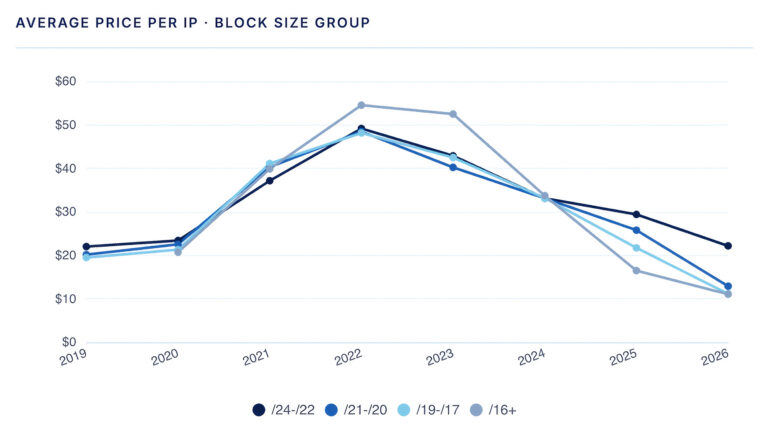 Source: ipv4.global
IPv6 is finally large enough to matter to IPv4 pricing. Google’s public measurement shows more than half of traffic to Google now arrives over IPv6, and APNIC’s measurements put global IPv6 capability at about 41.9% on a recent 30-day average. That does not “kill” IPv4 demand, but it does reduce the urgency of incremental IPv4 buying for some networks, especially where dual-stack or IPv6-first designs are now practical.
The practical conclusion for buyers is that the market is more nuanced than “IPv4 is expensive.” Small operational blocks are still expensive enough that due diligence matters; large blocks can look cheap but may require more capital, more routing work, and more careful fee modeling. For many operators, a blended strategy now makes the most sense: lease what you need in the near term, buy only if utilization is durable and long-lived, and accelerate IPv6 adoption where it can remove future IPv4 pressure.
Why IPv4 became a real market
The RIRs publish transfer frameworks and transfer records, but they generally do not publish the private commercial price of each transaction. RIPE publishes IPv4 transfer statistics and JSON logs of transferred blocks; ARIN publishes transfer charts; and APNIC documents transfer processes and logs; however, those official systems tell you that transfers occurred, not the price the buyer paid. That is why any long-term IPv4 price timeline has to rely on marketplace and broker reporting rather than registry price indexes.
That distinction matters because IPv4 pricing is no longer driven only by scarcity. It is also driven by the kind of scarcity involved. A clean, routable, operationally convenient /24 or /22 can trade very differently from a much larger block that is harder to absorb, subdivide, finance, or place. In other words, there is no single “IPv4 price” anymore; there are segmented prices by block size, region, reputation, and transfer path.
Timeline and analysis of IPv4 prices from 2019 to 2026
The table below is an analytical synthesis of indicative market pricing, not an official registry index. It combines broker- and marketplace-reported price points with registry context. That is the best currently available way to describe IPv4 pricing over time because official RIR statistics track transfers, not private deal prices.
| Year | Indicative price signal | What changed |
|---|---|---|
| 2019 | Roughly low-$20s per IP in the secondary market | RIPE’s final /22s were exhausted in November 2019, and the market was already much tighter than in the mid-2010s. |
| 2020 | Roughly low-to-mid-$20s; price growth paused | Early pandemic disruption slowed network expansion and temporarily suppressed demand. |
| 2021 | Prices more than doubled; some deals hit about $60 per IP | Demand snapped back, supply lagged because renumbering and consolidation projects did not restart quickly, and urgency widened price spreads. |
| 2022 | Large blocks averaged about $54.47 per IP in May | An unusual inversion emerged: large blocks carried a premium over smaller ones. |
| 2023 | /16+ blocks hovered around $50–$55; smaller blocks around the mid-$30s | Large blocks stayed expensive while smaller blocks softened, widening the size-based spread. |
| 2024 | Overall market commonly cited in the $30–$40 range, but large /16 blocks were still near $50 in mid-2024 before falling | The split between “headline IPv4 prices” and the weakening large-block market became much more visible. |
| 2025 | /16 average fell to just over $24 by March and below $20 by mid-2025; smaller /20–/24 blocks held near $31–$34 | Large-block prices collapsed while small-block pricing stayed comparatively sticky. |
| 2026 | Some /16+ transactions fell below $10 per IP, with broader large-block trend below $15; smaller blocks still materially higher | The large-block correction continued, but marketplace commentary in mid-2026 suggested spring lows may have passed as demand firmed again. |
The most important takeaway from that timeline is not merely that prices rose and then fell. It is that the meaning of “price” changed. In 2021, it was reasonable to talk about a broad market moving upward together. By 2025–2026, it was more accurate to talk about a structurally bifurcated market in which large blocks and small blocks behaved very differently. IPv4.Global explicitly describes the current environment as one in which small /20–/24 blocks can be more than twice the per-IP price of /16s.
One useful public chart source for ongoing monitoring is IPv4.Global’s live pricing reports, which aggregate marketplace sales reports over time. Another is IPXO’s market-stats page, which tracks lease-side pricing and utilization. For a longer historical visual showing pre-2020 price variation by deal size, IPv4 Market Group also publishes a public chart page.
What actually drives IPv4 pricing
Block size is still the first-order pricing variable. IPv4.Global’s reporting shows that from early 2022 through 2024, large blocks often traded at a premium to smaller ones, but by 2025–2026, the relationship had flipped in the opposite direction. That is a reminder that “bulk discount” is not a law in IPv4 markets; it depends on who the active buyers are and what sizes they actually need.
RIR region also matters because transfer rules and fee regimes differ. RIPE states that resource transfers are free of charge, but it also imposes a 24-month transfer restriction after resources are received. ARIN charges a $500 non-refundable transfer processing fee for each transfer request and requires recipients to document need, including 50% utilization within 24 months for larger blocks. APNIC states that approved IPv4 transfers require a transfer fee, and its Help Center says that fee is calculated as 20% of the annual fee applicable to the transferred resources. LACNIC’s published fee structure includes a $200 opening payment and then a larger administrative fee, commonly described as $1,000 for smaller than /19 and $1,500 for /19 and larger blocks.
Reputation is another major driver because not all IPv4 space is equally usable on day one. IPv4.Global’s reputation-reporting tool says it queries ten independent blocklist services and includes registry, routing, and geolocation data in its reports. That matters because a block can be technically transferable yet commercially painful if it has spam, phishing, abuse, or geolocation baggage. IPv4.Global separately notes that geolocation is part of IP reputation, as banks, retailers, and content networks use GeoIP in their decision-making.
Routing and security posture matter as well. RIPE defines a Route Origin Authorization as a cryptographically signed object stating which AS is authorized to originate a prefix. For buyers, that means RPKI and ROA status are not academic details; they affect whether the space can be announced cleanly and whether downstream networks will validate those announcements.
Finally, transaction friction matters. Brokerage fees, escrow steps, transfer processing fees, and regional paperwork can all affect the effective acquisition price. IPv4.Global’s FAQ says buyers incur a $1-per-IP fee with a $500 minimum, and its getting-started information says buyers can use an in-house escrow option or Escrow.com. IPv4 Market Group likewise describes escrow as part of its buyer process. When you compare two headline prices, what matters is the all-in landed cost, not the sticker price alone.
Buying versus leasing with example cost calculations
Leasing is now a mature alternative rather than a stopgap. IPXO’s public pricing page currently advertises campaign pricing of $0.25 per IP per month, states an average rate of $0.38 per IP per month, and shows a sample /24 at $66.87 per month, or about $0.261 per IP per month. At the same time, marketplace reporting indicates that lease pricing has generally softened and is more predictable than purchase pricing.
A straightforward example helps. If a buyer acquires a /24 at $30 per IP, using IPv4 Market Group’s recent-transfer illustration for /24 pricing, the purchase cost is 256 × $30 = $7,680 before registry, broker, and escrow costs. If that same buyer leases a /24 at IPXO’s current posted rate of $66.87 per month, the annual carrying cost is $802.44. In that simplified comparison, the crude break-even is about 9.6 years before accounting for transfer fees, financing costs, or the time value of money. That makes leasing especially attractive for projects with uncertain duration or rapidly changing geography.
A second example uses IPXO’s stated platform-wide average of $0.38 per IP per month. On that basis, a /24 costs $97.28 per month, or $1,167.36 per year. If you compare that with a representative small-block purchase level in the low-$30s per IP, the rough break-even falls to around 7 years. That is still long enough that many operators will prefer leasing unless they are very sure their IPv4 need is durable. This is an inference from current market pricing, but it follows directly from published lease rates and marketplace-reported small-block purchase levels.
In practice, buying makes more sense when you need stable, routable inventory for many years, want to control reputation recovery and routing policy directly, and can tolerate the upfront capital expense and transfer work. Leasing is often better when you need speed, want geographic flexibility, expect your IPv4 footprint to shrink as IPv6 grows, or simply do not want to commit capital into an asset whose large-block pricing has recently been highly volatile.
How IPv6 adoption is changing IPv4 demand and prices
The strongest evidence that IPv6 now matters to IPv4 economics is usage data. Google’s public IPv6 page showed a total of 50.91% on July 18, 2026, and the Internet Society Pulse documented the moment Google crossed the 50% threshold in late March 2026. APNIC’s global 30-day average measurement page recently showed world IPv6 capability at about 41.9%. This is no longer niche adoption.
That said, higher IPv6 adoption does not translate into a one-for-one collapse in IPv4 demand. Internet Society Pulse’s June 2026 research found that while 67% of initial domains in its website sample supported IPv6, only 47% of third-party dependency domains did. In other words, many websites are “IPv6-ready” at the front door but still depend on IPv4 somewhere in the dependency chain, especially for scripts, stylesheets, and fonts. That is one reason dual-stack remains the operational reality for a great many networks.
Still, IPv6 is clearly reducing upward pressure on the IPv4 market. Cloud pricing reinforces that trend. AWS charges $0.005 per public IPv4 address per hour, explicitly reflecting scarcity, and Google Cloud charges for static and ephemeral external IPv4 addresses used on standard VMs at the same $0.005-per-hour rate. Those recurring per-IP costs make it easier to justify an IPv6-first design, address consolidation, and more disciplined use of public IPv4.
The most balanced conclusion is that IPv6 is acting as a demand dampener, not an IPv4 replacement switch. It makes it harder to sustain 2021-style panic pricing, especially for large blocks, but it does not eliminate the premium on clean, easy-to-deploy smaller blocks that still solve real operational problems today. That reading is consistent with the current price divergence: large-block prices fell the hardest at the same time that global IPv6 usage reached its highest level yet.
Where to buy or lease IPv4 and how buyers should vet a block
The marketplace landscape is now broad enough that buyers should choose by operating model, not brand familiarity alone. Some platforms are better for transparent leasing; others are stronger for brokerage, inter-RIR navigation, or larger private transactions. The comparison below focuses on publicly available information and should be read as a starting point, not as an endorsement.
| Provider | Buy / lease / services | Public fee or pricing clue | Regional scope | Best fit and caveat |
|---|---|---|---|---|
| IPXO | Lease, monetize, acquire, abuse handling, KYC/RPKI, LIR services | Public lease pricing: campaign $0.25/IP/mo, average $0.38/IP/mo; sample /24 $66.87/mo | 15M IPs under management, 143 countries | Best for transparent leasing and operational automation; purchase-side economics are less transparent than lease-side metrics |
| IPv4.Global | Buy, sell, lease, auctions, analysis tools, escrow options | Buyer fee $1/IP with $500 minimum; escrow options published | Global broker/marketplace model | Strong for purchase-side analytics and large-block market color; small purchase fees can add up on larger blocks |
| InterLIR | Rent or buy IPv4, transfer assistance, LIR support | Publicly posted from €110/month for /24; €200 PA block transfer support; €150/month LIR support | Multi-region marketplace positioning | Good for buyers wanting hands-on transfer help and leasing; published price grid is more service-oriented than market-wide |
| Prefixx | Buy, sell, lease; inter-RIR transfer guidance | No standard public commission schedule found on main guidance pages | Registered broker with ARIN, RIPE NCC, APNIC; handles all major RIR transfers | Good for inter-RIR or broker-led deals; less transparent on public fee schedule |
| IPv4 Market Group | Buy, sell, lease, brokered escrow process | Public recent-transfer illustration shows /24 at $30/IP; no standard public commission table | Registered/approved in RIPE, ARIN, APNIC; global broker model | Useful for broker-guided deals and public pricing illustrations; published pricing is indicative, not a universal market quote |
Buyers should run a disciplined technical and policy checklist before signing anything. At minimum, verify the current registered holder in RIR WHOIS, confirm the seller is actually authorized to transfer, check transfer-lock and needs-based rules in the relevant region, review blocklists and abuse history, validate routing and ROA status, and inspect geolocation quality if your use case depends on country mapping or reputation-sensitive workloads. ARIN’s WHOIS service is the basic ownership check; RIPE’s RPKI pages explain the ROA test; RIPE and ARIN publish transfer restrictions; and IPv4.Global’s reputation reports explicitly bundle blocklist, routing, registry, and geolocation checks.
If you are buying in the ARIN ecosystem, it is also smart to confirm whether your facilitator appears on ARIN’s Qualified Facilitator list or can otherwise clearly document its standing. That does not guarantee a better price, but it does reduce procedural risk in a market where paperwork mistakes and policy misunderstandings can delay or derail transfers.