

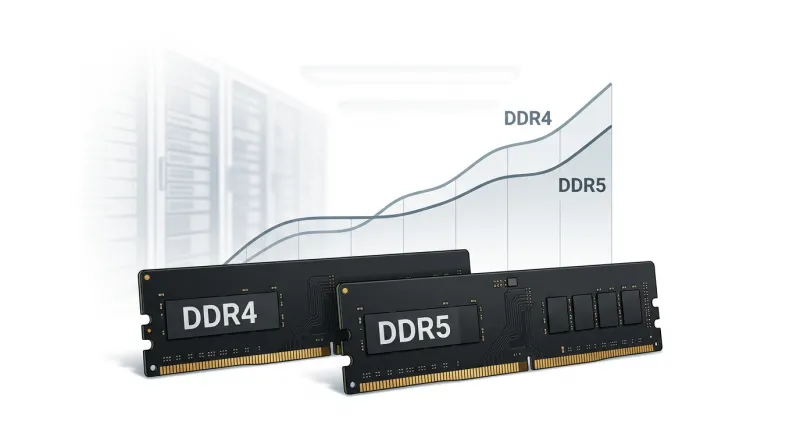
 If you are waiting for RAM prices to fall, the latest evidence from June–July 2026 does not yet show a broad market drop. The clearest read from the market is that price increases are slowing, but prices are still generally rising. TrendForce mentioned on July 3 that conventional DRAM contract prices are still expected to increase 13% to 18% quarter over quarter in the third quarter of 2026, even as consumer demand weakens. Micron mentioned on June 24 that DRAM and NAND demand still significantly exceeds supply and that tight conditions are expected to persist beyond calendar 2027. Reuters reported on July 8 that investors are increasingly worried about slower second-half memory price gains, but that is a signal of moderation, not a signal of an outright decline.
So the practical answer for buyers is straightforward: do not expect a meaningful, broad-based RAM price drop in July or, based on current public data, in the near term, into the third quarter. The first place you may see relief is in consumer retail kits, where buyers are already resisting higher prices and where deal volatility is much higher. By contrast, server RDIMM and enterprise memory still look firmer than the consumer side. That conclusion is an inference from TrendForce’s July 3 segmentation, the July 8 spot-market update, Micron’s June 24 outlook, and current retail tracking from Tom’s Hardware.
The July update
The newest market tone is best described as tight, expensive, and no longer accelerating at the same speed. TrendForce’s July 3 update says the DRAM market will remain “extremely tight” in the third quarter, but that weaker consumer demand and a higher comparison base should moderate contract-price gains. In other words, the market is no longer in the most explosive phase of the rally, yet it is still moving upward rather than downward. Reuters reinforced that on July 8 by reporting that investors are focused on whether memory price growth may slow in the second half of the year, while still noting that supply is expected to remain tight through the third quarter.
That distinction matters for a blog headline like “When will RAM prices drop?” because the freshest evidence does not say “drop now.” It says something closer to “the rally is cooling from extreme to merely strong.” TrendForce’s July 8 spot-market commentary adds that overall DRAM spot trading volume is still limited, with most buyers taking a wait-and-see stance, while some DDR4 categories edged up again. That is another sign of a market that has become more cautious, but not yet cheaper overall.
The clearest market signals
The best short-term indicators in early July are still pointing to firmness. TrendForce’s public DRAM price page, updated on July 8, showed a session-average price of 47.067 for DDR5 16Gb 4800/5600 chips and 76.925 for DDR4 16Gb 3200 chips. The same page also showed that, in module spot pricing, last updated on June 29, DDR5 RDIMM 32GB 4800/5600 averaged 1,375 and was up 3.00%, while DDR5 UDIMM 16GB 4800/5600 averaged 209 and was up 0.24%. That is not the profile of a market already rolling over.
TrendForce’s June 10 spot update was similarly firm. It said DDR5 demand was “especially strong,” buyers were showing higher willingness to accept elevated prices, and the average spot price of mainstream DDR4 1Gx8 3200 chips rose from $35.12 on June 3 to $35.90 on June 9. Then, in the July 8 update, TrendForce said mainstream DDR4 1Gx8 3200 rose again from $36.10 on July 1 to $37.14 on July 7. Even if spot activity has become quieter, those weekly moves do not look like the beginning of a clean downtrend.
There is also a broader market-level sign that the upcycle is still intact: Reuters reported on July 1 that, according to S&P Global Mobility, DRAM prices had risen about 70% since December. That does not tell you what will happen next quarter by itself, but it does confirm that the market entered July from a very elevated base rather than from a position of oversupply.
Where consumer memory may soften first
If RAM prices do start to ease anywhere first, the consumer channel is the most plausible place. TrendForce’s July 3 report says record-high contract prices mean customers in PCs and smartphones are hitting affordability limits, and it explicitly ties that to more moderate price increases in the third quarter. It also says higher-cost components are flowing into notebook pricing and are weighing on full-year shipment volumes. That is a classic sign that demand resistance is building on the consumer side, even if it has not yet produced a broad decline.
Retail tracking shows the same stress. Tom’s Hardware, in a RAM tracker last updated July 1, said DDR5 memory kit prices had surged over the previous trimester, with many kits showing triple or even quadruple increases from late 2025 levels. In its U.S. retail snapshot, a 32GB DDR5-5600 kit started at $369, while a 64GB DDR5-6000 kit was listed at $796. Tom’s also emphasized that exceptional deals are scarce and sell out quickly, and that availability remains limited, especially for higher-capacity DDR5 kits.
That combination usually means buyers should distinguish between “retail dips” and “market drops.” Retail kits can briefly drop due to promotions, bundle deals, or sudden restocks, even while the wholesale market remains firm. So, for desktop builders and upgraders, the most realistic July 2026 expectation is occasional deal windows, not a clean return to pre-shortage pricing. That is an inference supported by TrendForce’s view of consumer affordability pressure and Tom’s description of fast-moving retail volatility.
Why server memory still looks firm
The server side remains the least convincing place to call a near-term price drop. TrendForce said on July 3 that server DRAM will remain undersupplied in the third quarter, that x86 general-purpose servers using RDIMM remain the main memory platform for agentic AI workloads, and that server shipments are expected to remain robust through 2027 as CPU availability improves. It added that pricing gains should moderate somewhat because a portion of procurement is governed by long-term supply agreements, but “moderate” here still sits inside a market that remains undersupplied.
Micron’s June 24 earnings materials push in the same direction. In prepared remarks, the company said DRAM and NAND industry demand continues to significantly exceed industry supply and that it expects tight conditions to persist beyond calendar 2027. Its investor presentation also said it now expects DRAM and NAND supply-demand conditions to remain tight beyond 2027 and that server units in calendar 2026 should grow at a high-teens percentage rate. Those are company statements, so they should be read as interested-party guidance, but they are still highly relevant primary-source evidence about how one of the largest memory suppliers sees the market at the end of June.
This is why enterprise buyers should be cautious about waiting for a sudden Q3 bargain in RDIMMs. The freshest public evidence does not show one. At most, it shows that the pace of upside may be slowing. That is very different from saying that server memory is about to get cheap. Reuters’ July 8 report captured that nuance well: the issue investors were debating was slower price growth, not an imminent collapse in memory pricing.
Bacloud received prices from the wholesale market
The pricing background Bacloud received actually fits the current market picture quite well.
On the consumer side, your Crucial-style desktop DDR5 quotes are in the same broad range as the elevated retail market Tom’s Hardware was tracking on July 1. For example, your background list shows 32GB DDR5 kits at roughly $385 to $415 and a 64GB DDR5 kit at $710, while Tom’s U.S. tracker showed a 32GB DDR5-5600 kit at $369 and a 64GB DDR5-6000 kit at $796. The exact models, speeds, timings, and sellers are not identical, so these are not apples-to-apples benchmarks, but directionally, they tell the same story: consumer DDR5 is still expensive and not normalized.
On the server side, your Micron and Samsung enterprise module quotes also appear directionally consistent with a market that remains firm. In your background list, new Micron 64GB DDR5-5600 RDIMMs are quoted at around $2,149 to $2,639, clean-pulled 64GB DDR5-5600 at around $2,029, and Samsung 32GB DDR4-3200 clean pulls at $475. Again, those are not directly comparable to TrendForce’s public spot references because capacity, condition, channel, and region differ, but they sit alongside a public market picture where DDR5 RDIMM spot pricing was still rising at the end of June, server DRAM remained undersupplied, and overall contract prices were still expected to rise in the third quarter.
The bottom line
As of July 8, 2026, the best-supported answer is that RAM prices have not yet begun a broad decline. What the newest data shows is a market in which price increases are moderating, especially where consumer buyers are pushing back, but DRAM pricing is still generally moving upward in the third quarter and server memory remains tight. If you are waiting for a real market-wide drop, the latest June–July sources do not yet confirm one.
If relief appears first, it is most likely to show up as temporary consumer retail deals rather than a sudden wholesale reset in server memory. For enterprise and server buyers, the safer reading is that waiting for lower prices in the immediate term is still a speculative bet, not the trend the data is pointing to. In a single sentence: the July 2026 RAM market looks like a slowing rally, not a falling market.