

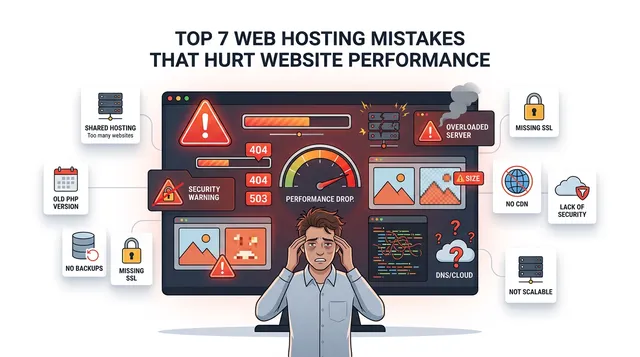
 A hosting plan may offer ample storage and sufficient resources for your website or application today. That does not mean it will handle future growth, traffic spikes, increasing database activity, or latency-sensitive workloads efficiently. Many organizations discover these issues only after page load times increase, transactions slow down, or users start complaining. The hosting mistakes below are among the most common reasons.
Choosing the wrong hosting tier for your traffic
One mistake we see quite often is selecting a hosting plan based mainly on storage, bandwidth, or monthly cost. During evaluations, these are usually the first things people compare because they are clearly listed on every pricing page. What often gets less attention is whether the underlying resources can support the application's actual workload.
A small company website or blog can usually run without issues on a basic hosting plan. The situation changes when you are dealing with WooCommerce stores, Magento deployments, learning management systems, customer portals, booking platforms, CRM systems, or ERP applications. These applications generate database queries, user sessions, and background processing tasks that place very different demands on infrastructure.
Before choosing a hosting tier, spend some time understanding expected traffic levels, database activity, and concurrent user volumes. That information usually leads to a much better decision than comparing hosting plans based solely on storage limits and pricing.
Bacloud offers fast and reliable shared hosting with LiteSpeed technology—perfect for WordPress websites. Enjoy fast loading speeds, security, and easy management. Get started today with Bacloud!
Hosting performance-critical applications on overcrowded shared servers
One of the most expensive hosting mistakes is treating all workloads the same during the evaluation process. Shared hosting and multi-tenant VPS environments are often chosen for their lower cost, but resource availability is only part of the equation.
This impact is most common in applications such as:
-
High-volume eCommerce platforms
-
Real-time analytics systems
-
Trading applications
-
AI inference services
-
Video processing applications
-
Complex SaaS platforms
These applications are highly sensitive to latency and resource contention. Even when sufficient CPU and RAM are allocated, performance can become inconsistent when other tenants on the same physical server compete for resources.
For these workloads, bare metal dedicated servers provide exclusive access to the underlying hardware. If consistent response times and predictable application performance are business requirements, investing in dedicated infrastructure is often the better long-term decision.
Ignoring server location and CDN setup
Server location is still one of the most missed performance factors during hosting evaluations. Organizations often look at hardware specifications while paying little attention to where their users are actually located.
Every request must travel between the user and the server. The greater the distance, the higher the network latency. This is particularly noticeable in dynamic applications where users generate frequent requests throughout a session.
A common mistake is hosting a globally accessed application in a single region without using a Content Delivery Network. A CDN will not reduce latency for dynamic transactions. It can, however, improve the delivery of static content. Images load faster when they are served from locations closer to visitors. JavaScript files and CSS files benefit too.
When evaluating hosting providers, infrastructure geography should be considered alongside other specifications. For many applications, placing servers closer to users can improve performance more than simply upgrading to larger hardware.
Choosing a hosting provider that still relies on outdated infrastructure
Another mistake is assuming that all hosting providers are running modern infrastructure. In many evaluations, very little time is spent examining the technology these service providers use.
It is still possible to find providers running older processor generations, aging network hardware, older Xen or VMware virtualization deployments, and web server stacks that have not been updated for years.
Before selecting a provider, ask how often infrastructure is upgraded and what technologies support the platform. Those discussions often reveal performance risks that you might face soon after signing up.
Choosing hosting without NVMe SSD storage
Many hosting evaluations compare storage capacity but spend little time evaluating storage performance. In applications, storage is no longer just a place to keep data. It directly affects how quickly applications retrieve information, execute queries, build caches, and process transactions.
A common mistake is assuming all SSD-based hosting delivers similar performance. Traditional SATA SSDs and NVMe SSDs are built on very different architectures.
NVMe storage offers several advantages
-
Lower storage latency
-
Significantly higher IOPS (Input/Output Operations Per Second)
-
Support for thousands of parallel command queues
Unlike SATA SSDs, NVMe drives communicate directly over PCIe lanes, reducing storage bottlenecks and allowing processors to spend less time waiting for data retrieval operations. This improves database responsiveness, cache generation, indexing tasks, and other storage-intensive processes that occur behind the scenes.
When performance is a priority, storage architecture deserves the same attention as processor generation, network design, and server location. In many cases, NVMe storage can improve application responsiveness without requiring additional CPU or memory resources.
Not planning for traffic spikes and growth
Many organizations select hosting based on average traffic rather than peak traffic. The problem is that infrastructure failures rarely occur during normal operating conditions. They happen when traffic randomly exceeds expected numbers.
Before selecting a hosting plan, review at least 6 -12 months of historical data. Start with your website analytics platform. Then, examine application monitoring data. Review CDN reports if you use a CDN. Server logs can also reveal important traffic patterns that are not visible elsewhere.
Look for patterns such as:
-
Seasonal traffic increases
-
Marketing campaign spikes
-
Product launches
-
Flash sales
-
Promotional events
-
Peak usage periods
A common mistake is choosing a plan without understanding how the hosting provider handles sudden demand. During the evaluation process, ask questions such as:
-
Does the platform support automatic scaling?
-
Are there burst limits on CPU, memory, network, or I/O resources?
-
How quickly can resources be upgraded if demand increases?
-
Will upgrades require downtime or migration?
-
What happens if traffic suddenly exceeds the allocated capacity?
Planning around peak demand rather than average demand helps prevent slowdowns, failed transactions, and service disruptions during the periods that matter most to the business.
Choosing unmanaged hosting without the technical resources to maintain it
Unmanaged hosting gives organizations full control over the server environment. The hosting provider provides the infrastructure, but responsibilities such as operating system updates, web server configuration, performance tuning, monitoring, and troubleshooting remain with the customer.
A common evaluation mistake is comparing managed and unmanaged hosting primarily on the monthly cost. The more important question is whether the organization has the in-house expertise and operational capacity to maintain application performance.
Before selecting an unmanaged platform, assess whether your team can support:
-
Monitoring CPU and memory, and latency trends
-
Optimizing web server, database, and application configurations
-
Managing caching and performance tuning
-
Detecting and resolving performance bottlenecks before users are affected
These responsibilities are often underestimated during procurement. A hosting environment may be correctly sized during the initial deployment, but without continuous monitoring and optimization, performance can gradually decline as application usage grows. In many cases, managed hosting produces better long-term results because dedicated infrastructure specialists continuously maintain and optimize the environment.
Why is Bacloud a strong choice for performance-critical hosting?
Avoiding the mistakes discussed above requires more than simply choosing a larger hosting plan. It requires selecting a provider that offers the right infrastructure for different application requirements and growth stages.
Bacloud addresses many of these challenges through dedicated servers, bare metal infrastructure, managed services, etc. Balcoud dedicated and bare metal servers provide direct access to hardware resources by helping organizations achieve greater performance consistency and lower latency for demanding applications. If you lack the time or in-house expertise to continuously monitor, tune, and maintain infrastructure, managed services help maintain application performance rather than treating optimization as a one-time deployment task.
Bacloud offers several infrastructure capabilities that directly influence application performance:
-
NVMe storage for lower latency and faster data access
-
Dedicated and bare metal servers with direct access to hardware resources
-
AMD EPYC and Intel Xeon-powered platforms
-
Datacenter locations across Europe and the UK to help reduce latency
-
Managed services for ongoing monitoring, optimization, and maintenance
Together, these capabilities help organizations build hosting environments that are better positioned for performance, scalability, and long-term growth.