

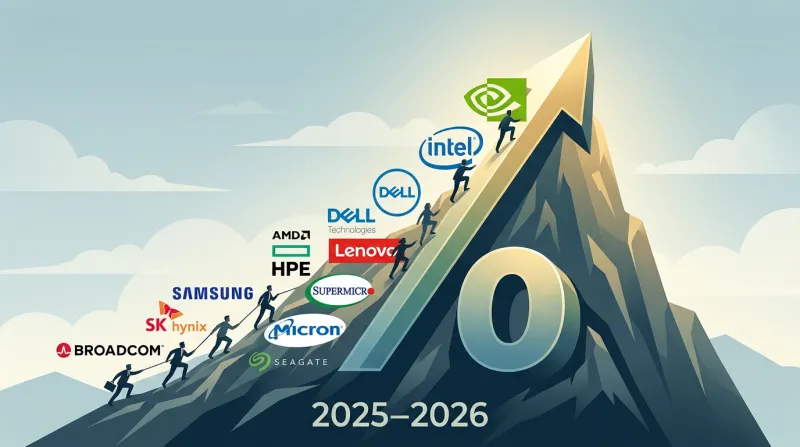
Server-component manufacturers saw strong 2025 results as AI and cloud infrastructure spending lifted demand and prices across the board. Memory-chip giants Samsung, SK Hynix and Micron posted record revenues and profits on surging DRAM/HBM and NAND prices. For example, Micron’s fiscal 2025 revenue jumped to $37.38 B (vs. $25.11 B in 2024) with GAAP operating profit of $9.77 B. Samsung’s semiconductor division (memories) hit an all-time high quarterly revenue (KRW 44.0 T) and operating profit (KRW 16.4 T) in Q4 2025, benefiting from HBM and server DRAM demand. Nvidia and AMD saw massive growth: Nvidia’s fiscal 2026 (ended Jan 2026) revenue was $215.9 B, up 65%, with $130.4 B operating income; AMD’s 2025 revenue grew 34% to $34.64 B (operating income $3.69 B). Server OEMs and integrators like Dell and HPE also grew 2025 sales, aided by higher server-unit prices and AI server orders (Dell FY2025 revenue +8% to $95.57 B). By contrast, Intel’s 2025 revenue was flat at ~$52.9 B with modest profit, reflecting a supply gap that is easing. Overall, 2025 vs. 2024 saw huge profit upswings for memory and GPU vendors, healthy gains for OEMs, while competition and supply constraints kept margins firm. Companies are forecasting continued AI-driven growth in 2026, but warn of potential oversupply, macro risks, and geopolitical uncertainties.
Market Drivers & Price Trends
AI/Hyperscaler Demand: Spending on AI data centers has surged, driving demand for high-end servers. Hyperscalers and cloud providers are “investing hundreds of billions… to train and run large language models,” boosting orders for servers and components. This has fueled a memory chip boom, with investors crowning Micron and Samsung as $1 trillion companies in mid-2026. Many customers locked in supply early: Micron reported all 2026 HBM capacity sold out. In GPUs, Nvidia sees AI processors driving unprecedented demand.
Supply & Pricing: The imbalance has tightened supply and lifted prices. In late 2025, contract DRAM and NAND prices jumped roughly 15–20%. Hyperscalers “aggressively secured” 3D NAND and HBM wafers. Tom’s Hardware notes this was “an off-season surge” as AI build-outs tipped the supply-demand balance. TrendForce and DigiTimes report seasonal price hikes, with DRAM up ~20% and NAND up ~20% in Q4 2025. Supply tightness extends beyond memory: Seagate and Western Digital warned of an HDD shortage, forcing cloud users to accelerate SSD purchases.
The net effect: manufacturers’ selling prices are well above 2024 levels. Memory vendors now enjoy strong pricing power – “supply chain constraints… have given [Micron] pricing power”. Western Digital raised HDD prices knowing AI data centers will pay for exabyte storage. GPU makers effectively saw high ASPs as demand far outpaced supply.
Lead Times and Inventory: Customers face longer lead times for AI-grade components. (For example, Intel noted Q1 2026 supply was at its lowest, implying tight availability.) Many cloud companies stockpiled inventory, affecting 2025 revenue (“record revenue above guidance”) but potentially pressuring retail channels later. Overall, the market is driven by AI and hyperscaler demand, memory/HBM growth, and disciplined supply, resulting in price-inflated 2025 results.
Major Memory/Storage Vendors
-
Samsung Electronics (Device Solutions): FY2025 revenue KRW 333.6 T (~$241 B), operating profit KRW 43.6 T. Memory division Q4 revenue KRW 44.0 T (+70% YoY) and op profit KRW 16.4 T. Samsung attributes the record quarter to strong HBM, DDR5 and SSD demand, saying “Memory Business set all-time high”. Guidance: Samsung expects HBM4 revenue in Q1 2026. Price impact: Samsung noted that memory chip shortages in early 2025 led customers to raise prices, and it secured a union agreement to prevent production cuts (impacting supply). Overall, Samsung’s margins have rebounded sharply in 2025 due to premium prices for advanced memory.
-
SK Hynix: (Public data limited) Q4 2025 operating profit KRW 19.2 T (≈$13.5 B), up 137% YoY. Analysts project full-year 2026 op profit ~KRW 216 T (quadrupled from 2025) on AI demand. Like Samsung, SK Hynix is benefiting from HBM and DDR5 price hikes.
-
Micron Technology: FY2025 (Sept 2024–Aug 2025) $37.38 B revenue, up 49% YoY. GAAP op profit $9.77 B (vs. $1.30 B in 2024) and net income $8.54 B. Non-GAAP op profit was $10.85 B. Micron’s Cloud memory business (HBM/AI memory) Q4 rev $4.543 B vs $1.449 B in Q4 2024. The company cited “tight supply and strong AI demand,” with pricing power from scarce high-bandwidth DRAM. Micron said “entire 2026 HBM supply sold out” – evidence of pricing tailwinds. Management sees ongoing pricing tailwind through H1 2026.
-
NAND/Storage Makers:
- Western Digital (WD): FY2025 (ended June 2025) $9.52 B revenue, +51% YoY. Q4FY25 rev $2.605 B, +30% YoY. GAAP op income $0.680 B vs loss $0.091 B year-ago. WD reported strong HDD demand (especially for data centers) and improved gross margin. CEO Irving Tan said HDD “will remain the foundation… for mass storage in an AI-driven future”, reflecting confidence despite rising SSD adoption. The large revenue gain implies WD was able to sell more drives at higher prices (or shift the mix toward higher-capacity models) to hyperscalers.
- Seagate Technology (Fiscal year ended July 2025): Not formally published here, but Q2FY2026 (ended Oct 2025) revenue was $2.83 B. CEO Dave Mosley noted: “AI applications amplify… need storage solutions”. Industry analysts expect Seagate’s FY2026 results to be up sharply due to AI demand. Seagate forecasts Q3FY2026 rev of $2.90 B on strong AI-driven backlog. Margins are high – EPS guidance of ~$3.40 implies robust profitability.
- Kioxia (Toshiba Memory): One of the world's largest NAND flash memory manufacturers, Kioxia is experiencing exceptional growth driven by rising AI infrastructure investments and increasing NAND memory prices. The company forecasts net profit of approximately ¥869 billion for the April–June 2026 quarter, representing a remarkable 48-fold increase year-over-year. Record demand from AI data center projects led by major technology companies such as Microsoft, Google, Amazon, and Meta continues to fuel revenue and profitability growth, while analysts expect further significant earnings expansion throughout fiscal 2026. Kioxia is also preparing a potential U.S. ADS listing to broaden its investor base and strengthen its access to global capital markets.
- Samsung (NAND): Samsung delivered one of the strongest performances in the NAND flash market during the latest reporting period. First-quarter NAND flash revenue reached approximately $13.5 billion, representing a remarkable 104.7% increase compared to the previous quarter. The company expanded its market share from 28.0% to 31.6%, further solidifying its position as the global NAND market leader. Growth was driven by higher NAND pricing, successful quarterly contract negotiations, and a significant increase in server-related shipments, particularly from AI and hyperscale data center customers, which substantially boosted average selling prices and profitability.
Overall, storage vendors’ revenues jumped. In Seagate’s case, shares more than tripled in 2025 on AI optimism. The high HDD and SSD prices lifted gross margins sharply.
CPU & GPU Companies
-
Intel: Full-year 2025 revenue $52.9 B, essentially flat vs. 2024. GAAP net loss $0.3 B (vs $18.8 B loss in 2024), as higher sales and cost cuts erased most losses. Non-GAAP net income $1.9 B. Data Center & AI Group revenue grew 5% to $16.9 B. Despite supply shortages (demand outstripping available wafer supply), Intel saw improved pricing. CFO Zinsner said Q1 2026 supply would be “at its lowest level” then improve in Q2, with “AI reinforces the importance of x86”. In short, Intel ended the 2024 slump and regained modest profitability, driven by a rebound in PC/server sales and improved cost control. Guidance for 2026 implies continued AI-driven demand, but caution regarding macro and competition (Intel did not provide numeric guidance in the press release).
-
AMD: FY2025 revenue $34.639 B (34% YoY). GAAP operating income $3.694 B (vs $1.900 B prior). Net income $4.335 B (vs $1.641 B). Growth was fueled by EPYC server CPUs and Radeon Instinct GPUs for data centers, as well as strong gaming sales. AMD’s CFO noted broad segment strength. AMD now includes Xilinx (FPGA) revenue. AMD did not explicitly cite price impacts, but industry context suggests AMD could sell nearly all server chips it produces at full ASPs; Gartner notes AMD’s rise in server market share. AMD’s 2026 outlook suggests continued datacenter CPU/GPU demand but some conservatism on PC; guidance is not in these excerpts.
-
NVIDIA: Fiscal 2026 (ended Jan 2026) $215.938 B revenue, +65% YoY. GAAP operating income $130.387 B, net income $120.067 B. (This is not a typo – Nvidia’s fiscal year is Feb–Jan and includes multiple quarters of AI boom. Q4 (Oct 2025) rev $71.9 B, net $42.96 B. The explosion came from data center GPUs: NVIDIA reported that its “AI semiconductor” revenue (GPUs, interconnects) soared by ~74% in Q4. Prices for high-end GPUs remained sky-high in 2025. Investors expect further growth: for Q1FY2027 (Apr 2026), NVIDIA guided for huge revenue again, reflecting continued GPU scarcity and demand. NVIDIA did not explicitly raise product prices (market prices did), but sold large volumes at record prices. Their margins are near 60%. For our table, 2025 revenue triple-digit billions stands out.
-
Marvell Technology: Marvell continues to benefit from the rapid expansion of AI infrastructure and hyperscale data centers. In the first quarter of fiscal 2027, the company reported record revenue of $2.418 billion, representing 28% year-over-year growth, while GAAP net income reached $34.5 million and non-GAAP net income totaled $718 million. Marvell's outlook remains exceptionally strong, with second-quarter revenue projected at approximately $2.7 billion, reflecting around 35% year-over-year growth. The company highlighted accelerating demand across its AI-focused portfolio, including 800G and 1.6T optical interconnects, 51.2T Ethernet switches, custom XPU accelerators, and AI networking solutions. Management also significantly raised its revenue outlook for both fiscal 2027 and fiscal 2028, citing record AI-related bookings and continued strength in the data center segment. Recent acquisitions of Celestial AI and XConn Technologies further strengthen Marvell’s position in high-speed optical connectivity and AI infrastructure, helping the company capture growing demand from hyperscale and AI-driven deployments.
Server OEMs and Integrators
-
Dell Technologies: Dell Technologies delivered a strong fiscal 2026 performance, reporting $95.6 billion in annual revenue, an increase of 8% year-over-year, while GAAP operating income reached $6.2 billion and net income totaled $4.6 billion. The company's Infrastructure Solutions Group (ISG), which includes servers, storage, and networking products, generated a record $43.6 billion in revenue, up 29% year-over-year, with operating income rising to $5.6 billion. Demand for AI infrastructure remained exceptionally strong, with Dell reporting a record $9 billion AI server backlog and significant growth in orders from hyperscale and enterprise customers deploying AI clusters. The company continues to benefit from rising average selling prices (ASPs) for AI-optimized servers, driven by increased demand for GPU-accelerated systems, advanced networking, and higher-cost server components. Looking ahead, Dell raised its fiscal 2027 outlook and expects continued growth as enterprises and cloud providers expand investments in AI infrastructure, high-performance computing, and next-generation data centers.
-
Hewlett Packard Enterprise (HPE): FY2025 revenue ≈ $34.3 B (+14% YoY). (HPE reported Q4 revenue of $9.7 B, +14%.) HPE’s full-year 2025 net loss was ~$59 M (vs. ~$686 M profit prior), due to heavy integration costs (Juniper) and goodwill charges. However, HPE’s management touted record Q4 gross profit margins and raised FY2026 EPS guidance. They attribute gains to accelerated sales of AI servers, networking (Juniper) and GreenLake cloud. Networking revenue (with Juniper) jumped +150%. HPE noted disciplined cost control. Hardware price impact: Like Dell, HPE effectively passed on higher component costs. CEO Neri highlighted a shift to an “AI infrastructure” focus, but sources note that HPE forecasts FY2026 revenue of +17–22%.
-
Supermicro: Supermicro remains one of the biggest beneficiaries of the AI infrastructure boom, driven by strong demand for GPU-accelerated servers, liquid-cooled systems, and complete AI data center solutions. In the third quarter of fiscal 2026, the company reported $10.2 billion in revenue, more than doubling from $4.6 billion in the same quarter a year earlier. Net income reached $483 million, compared to $109 million in Q3 fiscal 2025, while gross margin improved to 9.9%. Supermicro expects full-year fiscal 2026 revenue of $38.9 billion to $40.4 billion, highlighting the extraordinary growth of AI infrastructure deployments. The company attributes its performance to expanding demand across AI, cloud, and enterprise markets, as well as its transformation into a full data center infrastructure provider offering servers, storage, networking, power, and cooling solutions. Rising prices for AI servers, advanced GPUs, high-speed networking, and liquid-cooling infrastructure have helped increase average selling prices and profitability, while new manufacturing capacity in the United States positions Supermicro to capture continued growth throughout 2026 and beyond.
-
Lenovo Infrastructure Solutions Group (ISG): Lenovo emerged as one of the fastest-growing infrastructure vendors in 2026, benefiting significantly from the global AI infrastructure boom. For fiscal year 2025/26, Lenovo reported record Group revenue of $83.1 billion, while its Infrastructure Solutions Group (ISG), which includes servers, storage, edge computing, and AI infrastructure, achieved a record $19.2 billion in revenue, up 32% year-over-year, and returned to full-year profitability. In the fourth quarter alone, ISG generated a record $5.6 billion in revenue, growing 37% year-over-year, with operating profit reaching $202 million, the highest in the division’s history. AI infrastructure has become a major growth engine, with Lenovo reporting an AI server pipeline exceeding $21 billion and more than 5,800 customer AI deployments worldwide. The company continues to benefit from rising demand for GPU-accelerated servers, liquid-cooled AI racks, storage systems, and enterprise infrastructure, while increasing component prices and the shift toward higher-value AI platforms have contributed to higher average selling prices and improved profitability. Lenovo's rapidly expanding manufacturing capacity, including support for over 70,000 AI, compute, and storage racks annually, positions the company for continued growth as hyperscalers and enterprises accelerate AI infrastructure investments.
Overall, server OEMs saw mid- to high-double-digit growth in the server/storage segments, boosted by higher unit prices and large orders. A comparison: Dell’s ISG ops +30% in 2025. OEM gross margins were strong as chip makers raised pricing.
Networking & Infrastructure Chips
-
Broadcom: FY2025 revenue $63.887 B, +24% YoY. GAAP net income $23.126 B (vs $5.895 B), reflecting a huge jump from $23.7 B to $63.9 B in revenue. The jump was driven by AI-related products: Broadcom's CEO reported a record Q4 revenue of $18.0B (+28% YoY), with AI ASICs (AI accelerators and Ethernet switches) up 74% YoY. In the year, Broadcom’s semiconductor solutions sales were $36.858 B (+22%) (including switch chips and custom AI ASICs), and infrastructure software (VMware, etc) was $27.029 B (+26%). Broadcom raised Q1FY2026 guidance to $19.1 B (+28% YoY). Higher chip prices and volumes both fueled this growth; Broadcom’s non-GAAP EBITDA was $43.0 B (up 35%). Broadcom explicitly cites AI growth as the driver: “AI semiconductor revenue to double… driven by custom AI accelerators and Ethernet AI switches”. In short, Broadcom’s networking and AI chip segments got a major pricing tailwind.
-
Cisco Systems: Cisco is best positioned in the server hardware ecosystem through the networking layer rather than through CPUs, GPUs, RAM, or storage. Its products are critical for AI and cloud data centers, where large GPU clusters require high-speed Ethernet switching, routing, optical connectivity, security, and network automation. In Q3 fiscal 2026, Cisco reported record quarterly revenue of $15.8 billion, up 12% year-over-year, with GAAP net income of $3.4 billion and non-GAAP net income of $4.2 billion. The strongest momentum came from networking demand: total product orders increased 35% year-over-year, networking product orders grew by more than 50%, and data center switching orders rose by more than 40%. Cisco also reported $5.3 billion in AI infrastructure orders year-to-date and raised its expected FY2026 AI infrastructure revenue to approximately $4 billion. This shows that the AI hardware boom is not limited to GPUs and servers — it also significantly increases demand for high-performance network equipment that connects AI servers, storage systems, and data center clusters together.
Effects of Price Increases
Rising component prices directly boosted margins and profits at most vendors:
-
Memory & SSD: As noted, DRAM/NAND contract prices jumped ~15–20% in late 2025. Samsung, Micron and others reported much higher gross margins. For example, Micron’s gross margin soared (non-GAAP margin ~45% in late 2025 vs ~20% in 2024) due to high ASPs. Samsung’s memory division's operating margin hit a record high. Inventory revaluation gains (if any) also helped.
-
GPUs & CPUs: GPU prices were already elevated; AMD/NVIDIA effectively benefited from sustained high selling prices (especially for datacenter GPUs, which had multi-thousand-dollar price tags). NVIDIA’s non-GAAP gross margin was ~68% in Q4FY2026, at a historical high. AMD’s data-center GPU margins improved vs. the prior year. Intel improved its AI CPU margins following a product revision. Overall, chip makers' non-GAAP operating margins turned positive or expanded substantially (Intel's non-GAAP op profit turned positive vs prior loss).
-
HDD/SSD Makers: Western Digital and Seagate enjoyed price stability/hikes on enterprise HDDs in 2025. WD’s non-GAAP operating income jumped to $1.0B in Q4FY25 from a loss a year ago (see operating income swing). Pricing power on high-capacity HDDs and a temporary HDD supply crunch improved their profits.
-
OEMs: Server makers also raised prices on AI-optimized systems. Dell and HPE reported higher average selling prices (ASP) on servers by stuffing them with GPUs and faster memory. Dell’s ISG gross margin expanded (implied by a 15% rise in overall op profit vs. an 8% revenue gain). They indicated disciplined cost control, but higher prices for full system orders contributed to record margins.
Market Outlook and Risks (2026)
Looking ahead to 2026, companies generally expect continuing growth but note cautionary signs:
-
Outlook:
- AI & Hyperscale Spending remains robust. Broadcom guides Q1 FY2026 revenue +28% (vs Q1FY25). Dell sees FY26 rev +8%. Nvidia forecasts continued doubling of AI-focused sales, and firms like HPE are boosting guidance (raising FY26 EPS and networking revenue growth above 150%).
- Product launches (e.g., HBM4, new GPUs/CPUs, customized AI chips) are slated for 2026, which should sustain sales.
- Supply easing: Memory makers are ramping capex; Intel expects supply to improve after Q1. This could moderate price gains in late 2026.
-
Risks:
- Demand slowdown: If macro or AI spending cools, inventories could swell and prices could fall sharply (a feared “cycle collapse” in memory).
- Competition: Intel faces renewed challenges from AMD and Arm; GPU competition could emerge. Broadcom and Marvell must deliver on new products to keep pace.
- Geopolitics & Supply Chains: China tensions, export controls (AI chips) and industry consolidation (e.g., HPE-Juniper integration costs) introduce uncertainty.
- Customer Pushback: Large enterprises may resist ongoing price increases, and smaller buyers have already delayed some upgrades.
In summary, most server hardware vendors enter 2026 on strong footing. They are riding the AI wave, with rich 2025 profits cushioning R&D and investment. However, they warn that if supply catches up or spending wanes, the pricing environment could change. As one analyst notes, 2026 could see chipmakers capitalizing on “the massive amount of demand needed to run… AI revolution” – but only as long as that demand outstrips capacity.
Conclusion
The 2025 results underscore a pivotal industry shift: AI-driven demand has turned hardware makers into near-overnight winners. Memory vendors and AI chip companies reaped the benefits of skyrocketing prices, with many posting all-time highs in revenue and profits. Server OEMs also saw record sales by delivering high-end, AI-ready systems. Going into 2026, companies are generally optimistic – they’re expanding capacity and guiding for continued growth. Yet they remain wary of an eventual plateau in demand, supply-chain complexity, and geopolitical tensions. For now, the data center market’s “structural enhancements” (as Seagate’s CEO calls them) have translated into windfall earnings. Customers will have to absorb higher hardware costs in the short term, while hoping that innovation and scale will eventually bring prices down from these elevated levels.