

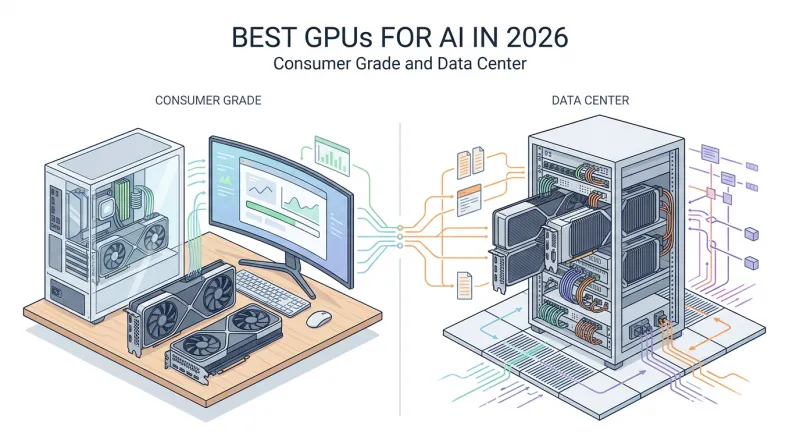
 AI adoption continues to explode, and GPUs remain the workhorse behind most modern AI applications. By 2025, NVIDIA alone controlled over 80% of the GPU market for AI training and inference. In 2026, NVIDIA still leads with its latest architectures, but AMD and Intel are pushing forward in both consumer and data-center segments. This overview compares the most popular AI-capable GPUs in 2026 – from gaming cards used by hobbyists to powerful accelerators in data centers – and makes recommendations for different users. We focus on real, shipping products (or imminently shipping ones), their memory, and their best use-cases, without favoring any AI model. Wherever possible, we cite official specs or reputable sources for memory size, bandwidth, and known performance.
| NVIDIA GeForce RTX 5090 (rumored) | Consumer Desktop | 32 GB GDDR7 | Local AI development, gaming |
| NVIDIA GeForce RTX 4090 (Ada, 2022) | Consumer Desktop | 24 GB GDDR6X | Enthusiast AI tasks and 4K gaming |
| AMD Radeon RX 9070 XT (RDNA4, 2025) | Consumer Desktop | 16 GB GDDR6 | Gaming/AI (CUDA not supported natively) |
| Intel Arc A770 (Battlemage, 2023) | Consumer Desktop | 16 GB GDDR6 | Mainstream gaming, some AI tasks |
| NVIDIA RTX PRO 6000 Blackwell (WS) | Workstation/Server | 96 GB GDDR7 (ECC) | Pro AI development, 3D/visualization |
| NVIDIA Tesla L40S (2023) | Enterprise/Server | 48 GB GDDR6 (ECC) | Inference, graphics-intensive AI |
| NVIDIA Tesla L4 (2022) | Enterprise/Server | 24 GB GDDR6 | Low-power inference, virtual desktops |
| NVIDIA A100 (Ampere, 2020) | Data Center/HPC | 80 GB HBM2e | Established AI training/inference |
| NVIDIA H100 (Hopper, 2022) | Data Center/HPC | 80 GB HBM3 | Cutting-edge AI training/inference |
| NVIDIA H200 (Blackwell, 2025) | Data Center/HPC | 141 GB HBM3e | Next-gen AI training/inference |
| AMD Instinct MI300X (CDNA3, 2023) | Data Center/HPC | 192 GB HBM3 | Large-scale AI training, HPC |
| Intel Data Center GPU Max (Ponte Vecchio) | Data Center/HPC | 64 GB HBM2e | Exascale HPC/AI (Aurora supercomputer) |
| Habana Gaudi 3 (Intel, 2024) | Data Center/HPC | N/A | AI training accelerator (AI workloads) |
Table: Representative AI-capable GPUs, their memory, and typical uses in late 2026.
Looking for a dedicated server to deploy your AI models? Bacloud offers dedicated GPU servers tailored to your needs. Choose from single to multiple GPUs per server and customize your hardware configuration accordingly. Request a quote today, and the Bacloud sales team will promptly get back to you with a personalized offer!
Get dedicated server for AI
Consumer and Prosumer GPUs
NVIDIA GeForce 40/50 Series (Ada/Blackwell) – Enthusiasts and developers gravitate toward NVIDIA’s latest GeForce cards because of CUDA/Tensor support and large VRAM. The top GeForce is expected to be the (rumored) RTX 5090 with 32 GB of next-gen GDDR7 memory, a 512-bit bus and roughly ~1.7 TB/s bandwidth. The 5090 is a desktop GPU powering local AI experiments and gaming. Even today’s flagship RTX 4090 (Ada Lovelace, launched in 2022) already offers 24 GB GDDR6X, which is sufficient for most single-GPU deep learning models. Lower down, the RTX 4060 Ti 16 GB (rebranded as 5060 Ti in later naming) provides 16 GB for smaller models. (For example, hobbyist fine-tuning of mid-sized LLMs often fits in 16–24 GB.) These NVIDIA cards dominate consumer AI setups due to their strong software ecosystem (CUDA, cuDNN, TensorRT) and fast mixed-precision cores.
AMD Radeon 9000 Series (RDNA4) – AMD’s consumer GPUs (RDNA4, launched in 2025), like the RX 9070/9080 XT, offer up to 16 GB of GDDR6 (for both the 9070 and 9070 XT). These cards deliver competitive gaming and some AI performance (using frameworks that support ROCm or DirectML), but they lack CUDA, so many ML workloads run slower or face compatibility issues. In practice, AMD’s high-end gaming GPUs see much less adoption in AI development than Nvidia’s. We mention them for completeness: RDNA4 cards have beefy CPUs and on-chip AI accelerators, but they are primarily marketed to gamers. A tech-savvy consumer could use an RX 9070 XT (16 GB) for moderate AI tasks, but for wide framework support and benchmarks, NVIDIA is still the safe bet.
Intel Arc – Intel’s Arc GPUs (Alchemist, Battlemage, Celestial) have up to 16 GB of GDDR6 and support oneAPI. They are improving but remain niche for AI in 2026. Enthusiasts mostly buy Arc for price-competitive gaming; for AI, support is still catching up. We note them here for completeness, but they are far less common in AI.
Workstation Cards – NVIDIA also sells professional “RTX PRO” and “RTX A” (formerly Quadro) GPUs with ECC memory for stability. For example, NVIDIA’s rumored RTX PRO 6000 Blackwell is said to pack 96 GB of GDDR7 ECC memory (in a dual-slot form factor) for large workstation models. Similarly, older cards like the RTX 6000 Ada (48 GB) or A6000 (48 GB) serve AI enthusiasts who need more VRAM and ECC. AMD offers Radeon Pro GPUs, but none in this class exceed ~32 GB as of 2026, so NVIDIA holds the edge for high-end workstations.
AI Data Center Accelerators
In data centers and clouds, the name of the game is memory capacity and interconnect, because models are huge and multi-GPU setups must shuttle data fast.
- NVIDIA A100 (Ampere, 2020): Still widely used in clouds. It has 80 GB HBM2e and ~2.0 TB/s bandwidth. It set the standard early on and remains a fallback choice for many CUDA workloads.
- NVIDIA H100 (Hopper, 2022): The mainstream NVIDIA AI accelerator in production now. The H100 SXM module comes with 80 GB HBM3 and ~3.35 TB/s bandwidth. It introduced fourth-generation tensor cores and a specialized Transformer Engine, offering roughly 3–4× the training throughput of A100 on large language models. Most cloud AI servers in 2026 still install many H100 GPUs, especially for training.
- NVIDIA H200 (Blackwell, 2025): The successor to H100, based on NVIDIA’s Blackwell architecture. It dramatically ups memory and performance. The H200 SXM has 141 GB HBM3e and 4.8 TB/s bandwidth (a 1.7× memory increase over H100). It also doubles tensor performance (FP8 up to 4 PFLOPS). H200 began shipping in 2025, powering new AI supercomputers and servers. There are also H200 “NVL” variants for air-cooled servers (same 141 GB). In practice, organizations running the largest models are deploying H200, while H100/A100 handle the rest.
- NVIDIA L-Series (Inference GPUs): NVIDIA's L4 and L40S are designed for servers that run AI applications and handle graphics workloads. The L40S has 48 GB of memory and is a good choice for more demanding AI tasks. The smaller L4 comes with 24 GB of memory and uses only 72 W of power, making it useful for servers where energy consumption matters. Both cards also support virtual desktops and other graphics applications. They are newer alternatives to the older NVIDIA T4 and A10 GPUs.
- AMD Instinct MI300X (CDNA3, 2023): AMD’s top AI/HPC GPU. It is a multi-chip module with 8 compute dies, offering 192 GB HBM3 and 5.3 TB/s of bandwidth – the largest per-GPU memory of any AI chip today. MI300X rivals the H100/H200 in raw AI flops (1.3 PFLOPS FP16, 2.61 PFLOPS FP16* with sparsity), and it’s optimized for HPC and LLM training. Major supercomputers (like Frontier) use MI300X/MI300A accelerators. Availability is more limited than NVIDIA’s, and software support relies on AMD’s ROCm stack, but MI300X is the go-to alternative for large-memory AI workloads on non-NVIDIA hardware.
- Other AMD: The previous MI250X (CDNA2) had 128 GB HBM2e and is still around, but MI300X has effectively replaced it. AMD’s Radeon Pro for servers (e.g., MI210) are far less common.
- Intel (Ponte Vecchio / Max Series): Intel’s first data-center GPU (codenamed Ponte Vecchio, marketed as Intel Data Center GPU Max Series) finally arrived on a large scale with the Aurora supercomputer in 2023. Each Ponte GPU carries up to 64 GB HBM2e (128 GB per dual-GPU node). Over 60,000 of these GPUs power Aurora. They support Intel’s oneAPI and have the Xe architecture (100+ Xe cores plus matrix extensions). Outside Aurora, adoption is small. But Intel’s effort shows up in 2026 with Xeon CPUs using HBM and new “Falcon Shores” XPU plans. For now, Intel GPUs are a niche in AI but notable in the exascale race.
- Habana Gaudi 3 (Intel): Habana Labs (an Intel unit) produces Gaudi AI accelerators. The latest Gaudi 3 launched in 2024. According to Intel, Gaudi3 delivers ~1.8× the performance-per-dollar of NVIDIA’s H100 on language models and costs much less per chip (servers built with Gaudi3 cost roughly one-third of comparable NVIDIA-based systems). It’s mainly for AI training and is sold as kits (e.g., Supermicro servers). Gaudi3’s exact memory is proprietary, but it’s competitive with H100. In practice, Gaudi is a smaller player (and Intel has said Gaudi 3 may be the last standalone Gaudi product), but it’s worth mentioning as an alternative.
Software Ecosystem
Most AI software is built with NVIDIA GPUs in mind. Tools like PyTorch, TensorFlow, and JAX support NVIDIA's CUDA, so running them on an NVIDIA card usually takes less effort.
AMD offers ROCm, which allows many AI applications to run on supported AMD GPUs. It works well for certain tasks, although software compatibility can still be more limited than with NVIDIA. Intel also has its own tools, including oneAPI and OpenVINO, but support for Intel GPUs is still developing.
If you're planning to use a GPU for AI, NVIDIA is usually the safer choice. Most AI tools support NVIDIA cards, so you're less likely to run into compatibility issues. AMD and Intel GPUs can also do the job, but you may need to spend more time getting everything to work.
Recommendations
- For enthusiasts/consumers: If you build or buy a single-GPU deep-learning PC, the NVIDIA GeForce RTX 50-series (if and when available) or current RTX 40-series are the top choices. In late 2026, that means RTX 5090 (32 GB GDDR7) or RTX 4090 (24 GB GDDR6X). They offer the largest VRAM and fastest Tensor cores for local AI workloads (e.g., model fine-tuning or generative AI experiments). Mid-range picks include RTX 4080 (16 GB) or RTX 4070 Ti (12 GB), but watch out – some 12–16 GB cards may be limiting for large LLMs. If budget is tighter, even an RTX 4070/4060 (~8–12 GB) or used RTX 3000 series can be workable for smaller models. AMD’s RX 9000-series (e.g. 9070 XT, 16 GB) can run some AI tasks (via ROCm or ONNX runtimes) but generally perform worse than NVIDIA’s equivalent because most DL libs are CUDA-first.
- For prosumer workstations: Look at NVIDIA’s workstation cards. E.g., the RTX PRO 6000 Blackwell (96 GB) or RTX A6000 Ada (48 GB) provide extra VRAM and ECC for large projects. These are overkill for casual use but essential if you train large models on-premises. On a smaller budget, prosumer gamers often repurpose GeForce cards (the 4090/5080, etc.) for serious ML because they’re more affordable.
- For data center training: It’s all about the H-series. If building a GPU cluster, the current mainstream is the H100 (80 GB) or A100 (80 GB) at the lower end, and the new H200 (141 GB) at the high end. Smaller deployments might use fewer H100s or even high-end consumer cards (e.g., a server with multiple RTX 4090s is sometimes used for prototypes). But for best performance, aim for H100/H200. NVIDIA’s B200/B300 Blackwell Ultra boards (multi-GPU modules with 180–288 GB total) are ideal for trillion-parameter models, though they are specialized and expensive. If you can’t get NVIDIA GPUs, AMD’s MI300X (192 GB) is a contender for big training jobs – it’s the go-to for any system built on AMD hardware (and AMD supercomputers).
- For inference/production: Lower-power inference cards like NVIDIA’s L4 (24 GB, 72 W) or L40S (48 GB, 350 W) are common in cloud services for serving AI models, especially with mixed graphics needs. These are effectively repurposed gaming GPUs with increased memory. Cloud platforms may also use TPUs or specialized accelerators (e.g., AWS Inferentia/Trainium), but for “GPU instances” it’s usually L4/L40 or lower-end H100. A single H100 can serve large LLMs at scale, but is costlier than deploying multiple L4’s for medium models.
- Cloud and hybrid: Remember you don’t always have to buy hardware. Many organizations rent GPU instances. AWS, Google, Microsoft and others offer A100/H100 instances (e.g., AWS p5/p6/P5d). For hobbyist use, even Google Colab or paid GPU cloud (like RunPod, vast.ai) can get you started on expensive GPUs without owning them.
Conclusion
In 2026, NVIDIA’s GPU lineup still dominates both hobbyist and datacenter AI. The RTX 40/50-series cards are the default choice for AI enthusiasts (up to 32 GB on the highest-end), thanks to CUDA support and raw performance. For prosumer and enterprise AI workstations, NVIDIA’s professional cards (with 48–96 GB) fill the gap. In data centers, NVIDIA H100/H200 remain the workhorses for training, while NVIDIA’s L-series and last-gen A100 are used for inference.
AMD’s big entry, the Instinct MI300X (192 GB), finally gives a true high-end alternative in data centers, and AMD RDNA4 GPUs (16 GB) serve enthusiasts who prefer Team Red (though with less ML support). Intel’s GPUs (Ponte Vecchio/Max Series and Gaudi3) made news in supercomputers and specialized training servers, but have only a tiny market share compared to NVIDIA.
NVIDIA remains the most popular choice for AI in 2026, both for home users and large data centers. GeForce RTX cards are a good option for people working with AI on their own computers, while H200, B200, and AMD Instinct GPUs are better suited for demanding data center tasks.
When choosing a GPU, consider its memory, price, and software support. More powerful GPUs are not always necessary, especially for smaller projects. NVIDIA is still the easiest option for most users because of its wide software support, although AMD offers good alternatives and Intel continues to develop its AI hardware.
The best GPU is simply the one that meets your needs without making you pay for performance you will never use.