

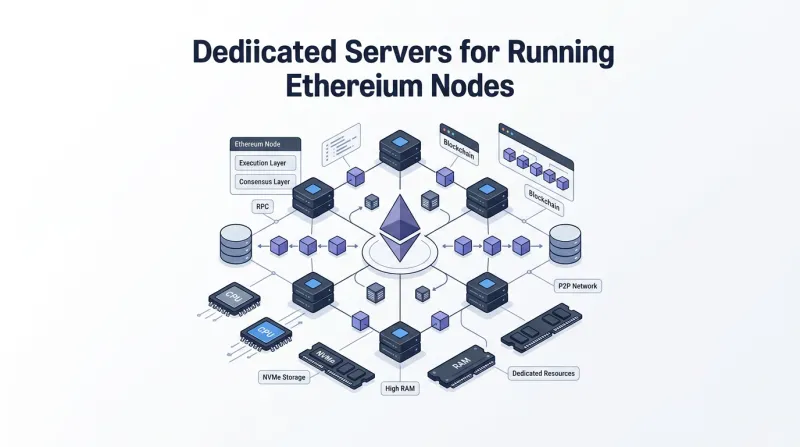
A dedicated server can run an Ethereum node that checks blockchain data and communicates with other nodes. Its CPU, memory, storage, and network connection are reserved for the node, rather than shared with everyday tasks on your computer. This article covers full, archive, and light nodes, their hardware needs, and the performance and security factors to consider when choosing a dedicated server.
What is an Ethereum node?
An Ethereum node is a computer running Ethereum client software that connects to other nodes and verifies blockchain data against Ethereum’s protocol rules. Ethereum is a peer-to-peer network: its nodes exchange data directly, rather than relying on one central server.
How an Ethereum node works:
-
Connects to other nodes to exchange blocks and transaction updates.
-
Checks transactions and blocks against Ethereum’s rules.
-
Updates its blockchain data when it receives valid information.
A standard node runs two clients to carry out these tasks. The execution client processes transactions and updates Ethereum’s latest state. The consensus client follows proof-of-stake rules and helps nodes agree on the current chain. Together, they keep the node synchronized with Ethereum.
Ethereum users usually access the network through a wallet or app, which sends requests to an Ethereum node. For example, the node checks the blockchain for an account’s balance or passes a signed transaction to the network. In this way, a node connects Ethereum users to the blockchain. People and organizations can also run their own nodes to connect to Ethereum without relying on a node operated by their wallet or app provider.
Bacloud offers dedicated servers tailored for Ethereum node requirements, whether you're setting up a full node or a validator for staking. Our servers feature high-speed NVMe storage, ample RAM, and powerful CPUs—perfect for Geth, Besu, or Nethermind clients. Choose Bacloud for reliable infrastructure, fast provisioning, and professional hosting built for blockchain performance.
What do you gain by running an Ethereum node?
Running an Ethereum node can give you these benefits:
-
Privacy: When you use a third-party node, its operator can see which Ethereum addresses your wallet asks about. Connecting your wallet to a node you operate keeps those requests away from that provider.
-
Independent verification: Your node checks blocks and transactions against Ethereum’s protocol rules, so you can confirm blockchain data yourself instead of relying only on a third-party node’s response.
-
Censorship resistance: Send transactions through your node to Ethereum’s peer-to-peer network, so you are less dependent on a provider that might refuse to handle them.
-
Decentralization: Add another independently operated computer that checks and shares Ethereum data. This helps reduce reliance on a small number of providers.
-
A voice during a fork: If Ethereum splits into competing chains, your node follows the chain supported by the software and rules you choose to run.
-
Control over your connection: Use a node you operate to access Ethereum, rather than depending entirely on infrastructure run by another service.
What types of Ethereum nodes are there?
Ethereum clients can run three types of nodes: full, archive, and light. They differ in how much blockchain data they download, verify, and keep.
Full node
A full node downloads and verifies blocks, including their transaction and state data. It keeps recent data locally; older state can be regenerated when needed. Some full nodes verify from Ethereum’s beginning, while others start from a more recent block they trust.
Archive node
An archive node verifies blocks from Ethereum’s beginning and retains historical states instead of pruning them. This supports queries about past data, such as an account balance at an earlier block. Archive data can require terabytes of storage.
Light node
A light node downloads block headers, which summarize block contents, rather than every block. It requests other data from a full node and checks that data against the state roots in the headers. Light nodes need less hardware and bandwidth than full nodes, and they do not participate in consensus.
Why run an Ethereum node on a dedicated server?
Running an Ethereum node on a dedicated server gives you control over how you connect to Ethereum, while keeping the node on a machine intended for continuous operation.
Control your setup and connection
By running a node on a dedicated server, you can choose and configure its execution and consensus clients. You can also connect compatible wallets and applications to your own RPC endpoint, so requests such as balance checks and transaction submissions go through your node instead of a managed provider. This reduces the information you share with that provider, including which addresses you query.
Depend less on third-party providers
With a node on a dedicated server, you can check blockchain data against Ethereum’s rules instead of relying on a provider’s response. You can also submit transactions through your node to Ethereum’s peer-to-peer network, reducing reliance on a third-party endpoint that could refuse requests.
Keep your node available
By hosting your node on a dedicated server, you can keep it online without leaving your personal computer running. This matters for validators, which need a synchronized node to attest and propose blocks. Validator downtime can reduce rewards and incur penalties, although a dedicated server cannot prevent every outage or remove the need for maintenance.
Support Ethereum’s decentralization
Decentralization means no single company or organization controls Ethereum’s network. By running a node on a dedicated server, you independently verify blockchain data and exchange it with other nodes. Each independently operated node adds another verification point, helping Ethereum avoid relying on a small number of node providers.
Why do dedicated servers improve Ethereum node performance?
Ethereum nodes continuously synchronize blockchain data and validate blocks and transactions. A dedicated server reserves hardware and network capacity for the node, reducing performance variation from competing workloads.
NVMe storage reduces I/O bottlenecks
Ethereum synchronization involves frequent storage reads and writes. An NVMe SSD dedicated to the node avoids I/O contention from other tenants. Lower, more consistent storage latency helps the execution client process state data, complete synchronization, and serve queries without disk access becoming the bottleneck.
Dedicated CPU and RAM reduce resource contention
Initial synchronization places substantial demand on CPU and memory. On a dedicated server, other customers’ workloads cannot consume those resources. This gives the node more predictable capacity to execute transactions, validate data, and respond to RPC requests.
Bare metal removes hypervisor overhead
Bare-metal hosting runs the node directly on physical hardware, without a hypervisor scheduling resources across virtual machines. This removes virtualization overhead and can provide more predictable CPU and storage performance under sustained load.
Stable network connectivity supports synchronization
Ethereum nodes exchange blocks and transactions with peers and serve RPC requests. A stable, high-bandwidth connection helps the node receive updates and respond to clients without network delays interrupting synchronization. For validators, delayed attestations can reduce rewards.
Why are dedicated servers more secure for Ethereum nodes?
A dedicated server gives the operator administrative control over the operating system, firewall, and node services. This supports a hardened configuration, but security still depends on correct access controls, patching, and key management.
Single-tenant hardware limits host-level exposure
A dedicated server runs one customer’s workloads on the physical machine, avoiding co-resident tenants on the same host. This reduces exposure to risks involving shared hypervisors and neighboring virtual machines, though it does not protect against operating system or node software vulnerabilities.
Firewall rules reduce the exposed attack surface
The operator can configure host and network firewalls to permit only required peer-to-peer ports and explicitly intended RPC access. Restricting inbound traffic reduces externally reachable services and helps prevent unauthorized access to administrative interfaces or APIs.
Access controls protect validator signing keys
On a dedicated server, you can restrict validator signing-key access through operating-system user permissions and by running the validator under a dedicated, unprivileged account. This limits which processes and administrators can read or use the keys, reducing the risk of theft or unauthorized signing. This matters because if a validator key is used to attest to two different blocks for the same slot, Ethereum can slash the validator.
DDoS protection helps filter attack traffic
With a dedicated server, you can choose a hosting provider that includes DDoS protection for the server’s network connection. The provider applies filtering across its network before traffic reaches your server; you can check or manage the protection through the provider’s control panel or support team. This helps filter malicious traffic before it consumes your server’s bandwidth and resources, keeping legitimate node connections available. The protection depends on the provider’s filtering capacity and configuration.
What are the hardware requirements for an Ethereum node?
Ethereum node hardware requirements vary by node type and client. A full node needs enough memory and fast storage to sync and verify blockchain data; an archive node needs much more storage to retain historical state. Light nodes use fewer resources because they download block headers instead of every block.
Minimum hardware
As a general baseline, plan for 4-8 GB of RAM and a 2 TB SSD as minimum figures for running a node. The exact requirements depend on the client and node configuration.
-
Light node: Requires less hardware and bandwidth than a full node. It downloads block headers and requests other data from full nodes.
-
Full node: Plan for at least 4-8 GB of RAM and a 2 TB SSD as a general baseline.
-
Archive node: Requires more storage than a full node because it retains historical state. Storage needs vary by client and configuration.
Recommended setup
These hardware and connection choices can make node setup easier:
-
Intel NUC: 7th generation or newer, with an x86 processor.
-
Wired internet connection: Optional, but it can make setup easier and provide a more consistent connection.
-
Display and keyboard: Useful for direct setup; not needed if you use DAppNode or manage the machine remotely over SSH.
These are general figures, not a complete server specification. Requirements vary by client and setup, so check the selected client’s current recommendations before choosing hardware.
Quick overview: hardware requirements for an Ethereum node
|
Node type |
CPU |
RAM |
Storage (NVMe) |
Bandwidth |
|
Light node |
2+ cores |
4-8 GB |
Minimal (headers only) |
10+ Mbps |
|
Full node |
4+ cores |
16 GB min, 32 GB recommended |
2 TB min, 4 TB recommended |
25+ Mbps, uncapped |
|
Archive node |
8+ cores |
32-64 GB |
~3-3.5 TB (Erigon/Reth), 18-20 TB (Geth) |
High, uncapped |
Why run your Ethereum node on Bacloud
Bacloud offers single-processor, dual-processor, bare-metal, and bargain dedicated servers, along with custom server quotes. Plans start at about US$85 per month. Choose a configuration with enough NVMe storage, memory, and bandwidth for your node type; higher specifications and additional services may cost more.
Bacloud provides dedicated hardware, IPMI access, and custom configuration options for blockchain workloads. View Bacloud dedicated servers, compare features, and sign up now.