


The domain name aftermarket is booming. In 2025, domain investors reported 93,100 sales totaling over $122 million in the first half of the year, a 42.7% increase in revenue over H1 2024. Domains are now traded like digital real estate: sellers list names on specialized marketplaces, and buyers browse hundreds of thousands of listings or bid in auctions. This guide reviews the leading platforms — from large general markets to niche auction sites — comparing fees, formats, and audiences so you can choose where to sell or buy a domain. The right marketplace depends on your domain’s type: a generic .com may sell fast via GoDaddy/Afternic, while a creative brandable finds the best audience on Atom.com. (For example, Sedo supports auctions, make-offer and buy-now listings in 17 languages, whereas Park.io focuses on ccTLD drops with simple backorder-auction sales.) Below is a detailed look at 11 major marketplaces + niche domain forums, followed by a comparison table, a seller’s checklist, and a visual timeline of a typical sale.
Sedo
Sedo is one of the world’s largest general-domain marketplaces, supporting fixed-price Buy Now listings, Make Offer listings, and timed auctions. It also offers domain parking and a global reseller network (SedoMLS) that syndicates listings to many registrars. Sedo handles escrow in-house and provides buyer traffic stats.
Use-case: General-purpose buying/selling of premium and niche domains. Good for international and keyword-rich .com/.net, IDNs and ccTLDs.
Seller Fees: 10% commission on Buy Now/parked sales; 15% on make-offer or auction sales. If a sale goes through the SedoMLS distribution (to partner registrars), the commission is 20%. (No listing fees.)
Buyer Options: Fixed-price purchase (“Buy Now”), Make Offer to negotiate, and timed auctions. No extra buyer fee (wire transfer option is fee-free). Sedo provides escrow.
Reach/Traffic: Millions of active domains listed globally. Sits in 17 languages and syndicates via SedoMLS, giving broad exposure especially in Europe and Asia.
Pros: Huge international audience; multiple sale formats; handles escrow/transfer smoothly. Low minimal listing requirements.
Cons: Moderate-to-high commissions (up to 20%); buyers may expect buyers to negotiate; slower sales on low-price items.
Best for: Sellers of keyword-rich or international domains who need global exposure. Buyers looking for end-user domains with safe escrow.
Looking for the perfect domain for your next website? ???? Bacloud offers a wide selection of domain extensions together with reliable hosting solutions. Get your Domain + Hosting in one place and launch your new website with everything you need. Find your domain. Choose your hosting. Start building.
GoDaddy/Afternic
GoDaddy operates two linked marketplaces. Afternic is GoDaddy’s domain listing platform, and GoDaddy Auctions sells both user-listed and expired domains. Listing on Afternic (especially with GoDaddy’s fast-transfer DNS) exposes a domain to 100+ registrar partners (GoDaddy, Namecheap, NetSol, etc.). GoDaddy Auctions is a subscription-based auction site for expired domains and user listings.
Use-case: Fast, fixed-price sales via Buy Now, plus auctions/negotiations. Afternic focuses on wide distribution, GoDaddy Auctions on volume liquidations and expired drops.
Seller Fees: Afternic charges a 30% commission of the sales price (25% plus a mandatory 5% “default boost” fee). Sellers who point their DNS to GoDaddy’s premium nameservers (enabling fast transfer on sale) receive a 20% commission discount (with a $15 minimum). GoDaddy Auctions charges 20–25% (roughly 20% on domains on their network DNS, up to 25% otherwise).
Buyer Options: Afternic/GoDaddy offer Buy Now with instant GoDaddy fast transfer, and Make Offer or Negotiate on Afternic. GoDaddy Auctions sells via timed auctions only (with optional backroom deals). A GoDaddy Auctions membership ($4.99/yr) is required for auction bids.
Reach/Traffic: Massive US audience. Domains listed via GoDaddy/Afternic appear as premium Buy-Now options on GoDaddy’s search results, Network Solutions, 1&1, and 100+ registrars. Very high search traffic and email promotions.
Pros: Instant sales via GoDaddy fast-transfer; unmatched exposure to retail GoDaddy customers; large pool of buyers looking for .coms.
Cons: High fees; $5 GoDaddy listing fee; Can be US-centric. Negotiations can take time.
Best for: Sellers with mainstream .com/.net domains (especially US market) who want quick, “Plug & Play” sales. Buyers who trust the GoDaddy brand and need immediate transfer.
DropCatch
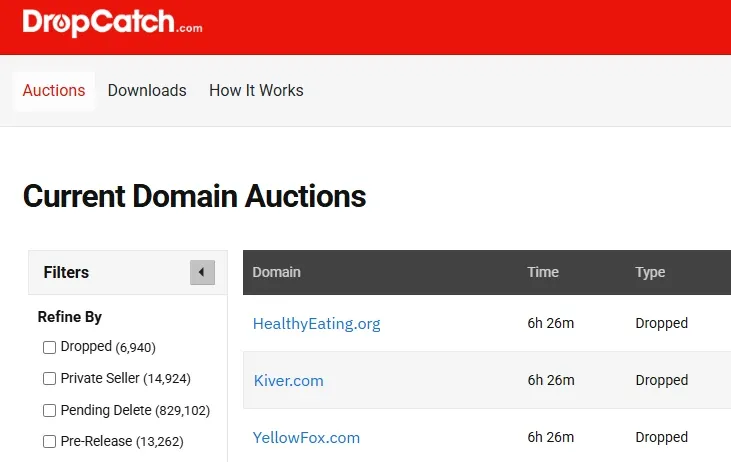
DropCatch is the leading expired-domain backorder service (powered by the NameBright domain registrar). Users place backorders on soon-to-drop domains; if multiple users vie for the same name, it goes to auction. DropCatch also offers a DropCatch Marketplace where acquired domains are resold (seller commission applies). It is distinct from GoDaddy Auction.
Use-case: Expired domain acquisitions. Catch highly competitive .com/domain backorders through backorder + auction. Also resell caught domains via auction.
Seller Fees: Backorder: Typically a $59 deposit (refunded if unsuccessful). Marketplace Sales: DropCatch charges sellers a 15% commission on each domain sale (deducted at the time of payment).
Buyer Options: Backorder a domain (≈$59 fee) and enter auctions if contested. In the DropCatch Marketplace, buyers participate in timed auctions (3-day) for listed domains. The highest bidder wins via NameBright transfer.
Reach/Traffic: One of the largest drop-catching pools (claims 1 million+ domains captured since 2006). High competition for popular drops. Marketplace visibility is lower than on Sedo/Afternic, but it has a built-in community of domainers.
Pros: Excellent for high-value expired .coms with established keywords/backlinks. Relatively low entry cost ($59) for a chance at premium names. Straightforward auction model.
Cons: Backordering is competitive; if contested, prices can surge in auctions. No Buy-Now option in the marketplace. Caught names are locked for 60 days before transfer.
Best for: Domain investors chasing expired .coms (especially single-word or generic names). Less useful for brandable or new TLDs.
NameJet
NameJet (under Web.com's control) is a primary platform for expired and high-value domain auctions. It hosts daily auctions of once-owned domains (often from registrar portfolios or pre-release lists from dropping registries). NameJet also works with registrars like Network Solutions and Register.com.
Use case: Auction sales of expired .com/.net domains. Often features “Premium” auctions with hand-selected valuable names.
Seller Fees: Commission is 20% of final sale price (no listing fee). High-tier “live event” auctions (brokerage-style) can have a 15% commission. A handling fee applies for late transfers ($100 if not pre-transferred to NameJet).
Buyer Options: Timed auctions only (usually 5-7 days). NameJet occasionally offers a “Buy Now” if an auction ends with no bids (rare). No Make Offer.
Reach/Traffic: Well-known among domain investors in the US. Traffic is moderate; auctions get promotion in newsletters. No global syndication network.
Pros: Good selection of higher-quality expired domains. No listing/list fees, transparent auctions. Reputable escrow.
Cons: Smaller buyer audience than Sedo/GoDaddy. Long auction durations (domains can take weeks to sell). Exclusivity: if you win, you must finalize through NameJet.
Best for: Investors seeking expired .coms or aged domains via auction (especially those dropped by big registrars). Sellers of select high-value names via vetted auctions.
SnapNames
SnapNames (also under Web.com management) is another major expired-domain platform, similar to NameJet. Historically, it specialized in registrar drops (Verisign-backed .com deletes) and auctions of backordered names.
Use-case: Expired domain backorders and auctions, often for general TLDs including gTLDs and ccTLDs.
Seller Fees: Like NameJet, SnapNames charges a 20% commission on standard auctions. Premium auctions (hand-picked events) have a 15% rate. (No listing fee).
Buyer Options: Timed auctions. SnapNames also offers a “Buy Now” on certain auctions if bidding fails. Users place backorders (often $59) and win by bid or by being the sole bidder.
Reach/Traffic: Large pool of domainers, with some international participants. Overlaps with NameJet’s audience; less U.S.-centric than GoDaddy, more professional investor base.
Pros: Robust auction platform with many .com drops. Transparent rules and escrow by SnapNames Registry (pays backorder winners).
Cons: Less marketing; dated UI/UX. Inventory overlaps NameJet. Same exclusivity rules on sale.
Best for: a similar use case to NameJet – catching expired domains via auction. Useful if you want multiple backorder services to increase odds (NameJet + SnapNames + DropCatch).
Park.io
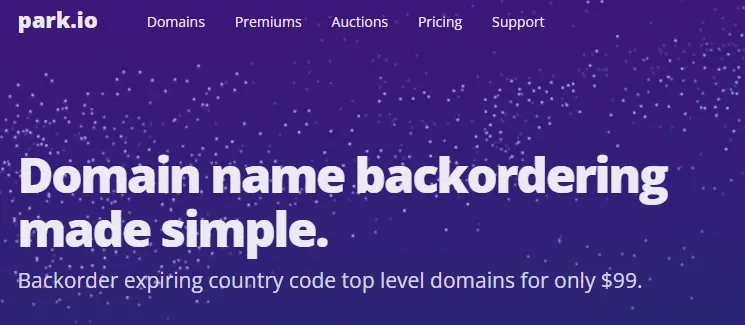
Park.io is a specialty backorder/auction service for select country-code TLDs: primarily .io, .sh, .ac, .co, .ly, and some others. It allows users to backorder expiring ccTLDs and holds auctions when multiple backorders collide. Park.io then registers the name under its own umbrella and transfers it to the winner.
Use-case: Backordering and auctioning domain names in tech/creative TLDs (notably .io). Also has a marketplace for listed “premium” names.
Seller Fees: No traditional commission. If you are the sole winner of a backorder, you pay the backorder fee. All winning bids go to Park.io, which covers registration (the buyer sees only the final price).
Buyer Options: Backorder a domain by paying a $99 fee (charged only if successful). If only one backorder is placed, that bidder wins for $99. If multiple backorders are placed, Park.io holds a live 3-day auction. The highest bidder pays their bid (including Park.io’s domain fees).
Reach/Traffic: Niche but popular among tech startup founders and developers worldwide. Park.io is well-known for transparent, fair auctions (no last-second sniping) and has a community of backorder enthusiasts.
Pros: Simplified pricing ($99) and process; focuses on valuable TLDs (.io, etc.) not covered by other services. High success rate for these TLDs.
Cons: Very limited to a handful of extensions. Relatively low liquidity on everyday .com names.
Best for: Buyers/sellers of tech/geek TLD domains (.io, .sh, .co). Not useful for .com or everyday generics.
Atom.com

Atom.com (ex BrandBucket) is a curated brandable domain marketplace. It focuses on catchy, invented names (usually .com), professional logos, and detailed descriptions to appeal to startups and agencies. Every listed name undergoes editorial review; unapproved names are not listed.
Use case: Selling creative, brand-friendly names (e.g., Shto.io, Funly.com). Each listing includes a custom logo mockup. Transaction is fixed-price only.
Seller Fees: A $1 appraisal fee per submission (used to evaluate market value). Commission is tiered by price: 30% for sales <$10K, 25% for $10K–$49,999, 20% for $50K–$99,999, and 15% for $100K+. (Pay-per-list or exclusivity arrangements do not apply.)
Buyer Options: Fixed-price Buy Now. There is no auction or offer system, but buyers can inquire. Escrow is handled by the platform.
Reach/Traffic: Targets startups and branding agencies, mostly U.S. entrepreneurs and tech firms. Atom actively markets names via content and partnerships. Traffic is smaller but highly qualified.
Pros: High-brand-quality presentation (logos, descriptions) that can justify premium prices. Access to design-centric buyers. Managed escrow and negotiation by in-house sales team.
Cons: Very high commissions (up to 40% for Atom tier) relative to general markets. Strict editorial standards mean many names get rejected.
Best for: Domain owners with creative, pronounceable .coms that might appeal to new companies (e.g., short invented words). Not for generic keyword names.
BuyDomains
BuyDomains (formerly Buying.com) is a premium domain sales service owned by Newfold Digital, Inc. (formerly Endurance International Group). It operates as a brokerage and marketplace: listing thousands of valuable domains (often one-word .coms) and fielding buyer inquiries. It also offers a new “third-party brokerage” program to list outside domains.
Use-case: Selling high-end domains via brokerage approach. Focus on single-word .coms and premium inventory. Listings are fixed-price with negotiation handled by their sales team.
Seller Fees: Not fully public. Traditionally, BuyDomains kept around a 20–35% cut from sales, but they now negotiate on a case-by-case basis. (An October 2018 report said “commission structure will vary depending on the domain”.) Sellers pay nothing upfront to list.
Buyer Options: Buyers can make offers or request quotes on listed domains. Payments are made via their escrow (for the Seller’s benefit). No auctions, only brokered deals.
Reach/Traffic: Thousands of buyers visit buydomains.com to browse high-end names. It has a professional sales team and advertising reach through hosting portals. Less retail traffic than GoDaddy, but targets serious corporate buyers.
Pros: Access to broker expertise, marketing support, and a large built-in inventory. Good for sellers who don’t want to self-market.
Cons: Opaque fees; commissions can be high. Domain must be very high-value for acceptance. Negotiations can drag on, and the payoff is uncertain.
Best for: Owners of premium brandable or keyword .com names (typically five- or six-figure ranges) who want full-service selling. Less ideal for DIY sellers of lower-valued names.
Dynadot Auctions
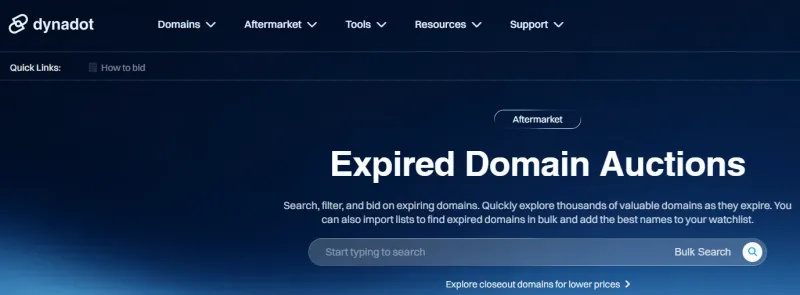
Dynadot is a registrar offering several secondary-market features. In addition to expired auctions and closeouts, it offers Premium User Auctions: a curated selection of high-quality domains owned by Dynadot users. Domains must meet certain criteria to be approved.
Use-case: Selling domains via timed auctions; also supports standard “Buy It Now” listings in its Market Overview. Premium User Auctions run 10-day auctions of selected names.
Seller Fees: Commission is 15% of the final bid price (no listing fee). Sellers must submit domains for approval first. Escrow (EPP transfer) is handled by Dynadot.
Buyer Options: Auctions only (for Premium). Dynadot also runs daily public “User Auctions” and “Expired Auctions” on high-volume names, but those are not individual user listings. As a Dynadot registrar user, you can also list domains at Buy-It-Now prices, paying the same 15% if sold.
Reach/Traffic: Large Dynadot customer base, plus exposure through Dynadot’s newsletters and on-site promotion. Not as broad as Sedo or GoDaddy, but a sizable niche community (Dynadot is popular with small investors).
Pros: Relatively low seller fee (15%). Seller controls reserve prices. No extra listing cost. Auction gains traction over 10 days.
Cons: Audience limited to Dynadot users and their promotion channels. Domain must be pre-approved and not withdrawable. Fewer buyers than major marketplaces.
Best for: Sellers who want an easy auction entry with decent fees. Good for .com/.net domains that meet Dynadot’s premium criteria. Buyers seeking bargains in Dynadot auctions.
Namecheap Market
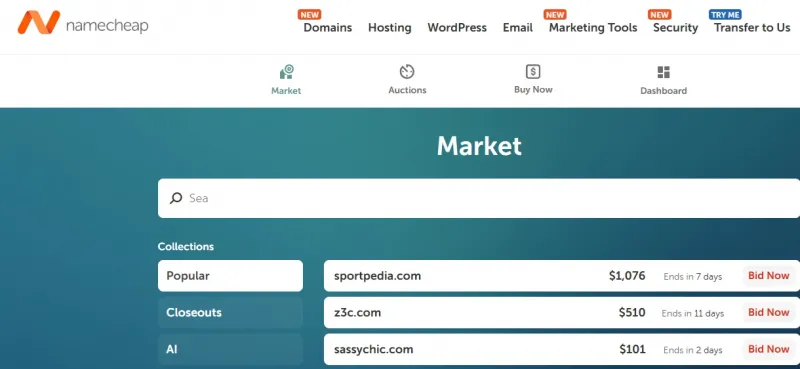
Namecheap’s Domain Market is a built-in peer marketplace integrated into the domain search interface. Namecheap users can list owned domains at fixed prices and other Namecheap customers can buy them. It’s intended for straightforward small-scale sales.
Use-case: Fixed-price direct sales of domains (no auctions or offers). Useful for common extensions including .com, .net, and some handpicked new TLDs.
Seller Fees: 10% flat commission on each sale (no listing fee). Escrow and transfer are included. Payout is processed when the buyer completes the purchase.
Buyer Options: Simply Buy Now a listed domain (much like buying a registration, but at the seller’s price). Buyers must have a Namecheap account or register.
Reach/Traffic: Namecheap has 10+ million customers. Traffic depends on organic search and newsletters. It’s smaller than Sedo/GoDaddy but has been growing as Namecheap encourages inventory listing.
Pros: Low fee and easy listing process (just point Name Servers to Namecheap and list). Quick sale and transfer through Namecheap’s platform. Good escrow.
Cons: Very limited buyer pool (only Namecheap domain shoppers). Few visitors specifically looking at used domains.
Best for: Domainers wanting a simple, low-cost listing of generic domains (especially newbies). Buyers who already use Namecheap and prefer an integrated experience.
Flippa
Flippa is a marketplace for websites, apps, and digital assets — including domains. While its focus is on revenue-generating sites, it has a robust section for premium domains, particularly those bundled with websites or traffic.
Use-case: Selling developed sites and premium domains via listing + auction. Domain listings are tiered (listing fee plus success fee).
Seller Fees: Listing fee ($29–$99 depending on tier) plus a 5–10% commission on sale. (Higher tiers and brokerage services increase fees.)
Buyer Options: Auctions (timed listings) and Buy Now. Escrow is handled by Flippa. Buyers can view site metrics and place bids.
Reach/Traffic: Very high exposure among tech entrepreneurs and investors. Flippa has millions of site visitors monthly. Good for high-value sales.
Pros: Access to a large audience interested in digital businesses. Can highlight traffic/revenue of a bundled site to boost price. Active bidding environment.
Cons: High fees and listing costs (especially for premium exposure). Many listings are lower-priced; stand-alone domains can get less attention unless exceptional.
Best for: Sellers of premium domains with websites or revenue. Also end-users who value site metrics. Not ideal for purely undeveloped domains.
Comparison of Key Features
| Marketplace | Seller Commission | Formats (Buyer Fees) | Primary Use-case / Reach |
|---|---|---|---|
| Sedo | 10% (Buy Now); 15% (offer/auction); 20% (MLS) | Buy Now, Make Offer, Timed Auctions (no buyer fee) | General global marketplace (multilingual; SedoMLS network) |
| GoDaddy/Afternic | 20% (Fast-Transfer deals); 30% (standard; 25%+5% boost) | Buy Now (fast transfer), Make Offer (Afternic); GoDaddy Auctions (paid auction membership) | Premium .com distribution (100+ registrar partners) |
| DropCatch | 15% on marketplace sales (NameBright)† | Backorders (~$59 fee) & auction (buyer pays winning bid) | Expired .com capture (largest drop network) |
| NameJet | 20% (standard auctions); 15% (premium/live events) | Timed auctions only (no listing fee) | Premium expired .com/.net auctions (Network Solutions) |
| SnapNames | 20% (standard); 15% (premium events) | Timed auctions (no listing fee) | Expired domain auctions (Verisign drops) |
| Park.io | 0% (domain registration is paid by buyer) | Backorder $99 (only if domain won); auction if contested | ccTLD backorders (.io, .co, .ly, .sh) with automated auctions |
| Atom | 30–40% tiered (see above) | Fixed-price only (no buyer fee) | Curated brandable .coms (pre-made logos, creative startups) |
| BuyDomains | Varies (~commission, case-by-case) | Negotiated fixed-price (broker-assisted) | Brokered premium .com sales (high-value portfolios) |
| Dynadot | 15% (Premium auctions) | Timed auctions (10-day); fixed listings | Curated auctions for quality names; Dynadot user base |
| Namecheap | 10% flat | Fixed-price Buy Now (no buyer fee) | Registrar marketplace (simple sales via Namecheap) |
| Flippa | 5–10% + $29–$99 listing | Auction and Buy Now (no buyer fee) | Digital assets & domains (especially revenue-generating sites) |
† DropCatch details: Backorder $59–69; 15% seller commission on sold names.
Forums & Community Marketplaces
NamePros and DNForum: Beyond official sites, domainers trade directly on forums. NamePros (world’s largest domainer forum, ~1 million members) and DNForum (one of the oldest, ~45,000 members) each have active Marketplace sections. Users can list items for sale (with Buy‑Now, Make‑Offer, or auction), ask for offers, or broker deals privately. Sales via “lander” pages on these forums also occur (e.g., a $38.8K sale of Clearly.co was reported via a NamePros landing page).
While these forums are less formal than Sedo/Afternic, they’re valuable for networking and catching private deals.
Usage: Post a “For Sale” thread or answer buyer requests. Payment/transfer is done via an agreed escrow.
Pros: Zero commission (forums don’t take fees); direct contact with motivated buyers/sellers; great for mid‑range domains or unique deals.
Cons: Smaller audience than big marketplaces; you handle escrow/transfer yourself (though many use Escrow.com or PayPal).
Seller’s Pre-Listing Checklist
Before listing your domain, ensure you:
- Confirm ownership and status: Unlock the domain, remove any transfer/renewal blocks, and verify WHOIS contact info is current (ICANN rules require accurate info).
- Optimize the listing: Create a clear, professional landing page (or park page) highlighting the domain’s keywords or usage. Good traffic stats (like Alexa rank or analytics data) help, so gather any relevant metrics.
- Set a realistic price: Research comparable sales (using NameBio or DNJournal) to determine pricing that aligns with market demand. On platforms that allow offers, consider listing slightly above your minimum to leave room for negotiation.
- Prepare materials: For curated sites (Atom, etc.), a logo or branding package can boost appeal. Write a concise, benefit-focused description of the domain. Have any traffic, revenue or SEO stats ready if selling on marketplaces.
- Choose escrow: Decide how you’ll handle escrow. While many marketplaces include escrow, ensure you’re ready to use services like Escrow.com or the platform’s escrow to guarantee secure transfer for both parties.
Conclusion
There is no single domain marketplace that is best for every buyer or seller. Large platforms such as Afternic, GoDaddy, and Sedo are generally the strongest options when maximum exposure and access to a broad international buyer base are the priority. DropCatch, NameJet, and SnapNames are much more useful for acquiring valuable expiring domains, while specialized marketplaces can work better for brandable names, specific extensions, or niche buyers.
For sellers, the best strategy is usually to balance marketplace reach, commission rates, and the type of domain being offered rather than simply choosing the platform with the lowest fee. Buyers should also compare several marketplaces, especially when searching for premium or expired domains, because inventory and acquisition methods can differ significantly between platforms. Whether you are selling an unused domain, building a domain investment portfolio, or searching for the perfect name for a new business, using the right marketplace can make the transaction faster, safer, and potentially much more profitable.